
LDW system operation
The LDW system operates above approximately 43 MPH (70 km/h).
When the vehicle approaches either the left or the right of the traveling lane, the LDW system will chime a sound and the LDW light (orange) on the instrument panel will blink to alert the driver.
The LDW system is not designed to operate under the following conditions.
• When you operate the lane change signal
and change traveling lanes in the direction of
the signal. (The LDW system will become
operable again approximately 2 seconds
after the lane change signal is turned off.)
• When the vehicle speed is less than
approximately 43 MPH (70 km/h).
After the above conditions have finished and the necessary operating conditions are satisfied, the LDW functions will resume.
Turning on or off the LDW system
The LDW system is turned on or off using the setting menu on the center display.
SYSTEM ON:
The LDW light (green) on the instrument panel will light up.
SYSTEM OFF:
The LDW light (green) on the instrument panel will go out.
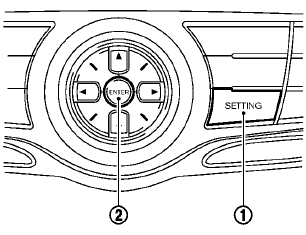
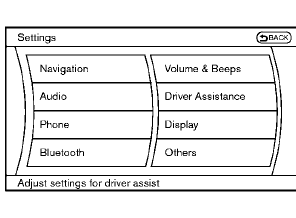
Perform the following steps to enable or disable the LDW system.
1. Push the SETTING1 button and highlight the “Driver Assistance” key on the display using the multi-function controller. Then push the ENTER2 button.
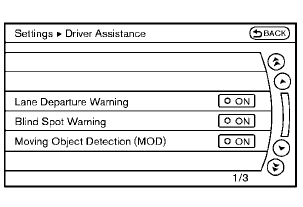
2. Highlight the “Lane Departure Warning” key, select ON (enabled) or OFF (disabled) and push the ENTER2 button.
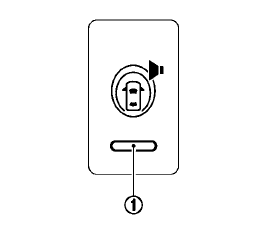
Warning systems switch
The warning systems switch is used to temporarily turn off the warning systems (Lane Departure Warning (LDW) and Blind Spot Warning (BSW) systems) that are activated using the settings menu.
WARNING
• The camera unit may not be able to detect properly under the following conditions:
— On roads where there are multiple
parallel lane markers; lane
markers that are faded or not
painted clearly; yellow painted
lane markers; nonstandard lane
markers; or lane markers covered
with water, dirt, snow, etc.
— On roads where the discontinued
lane markers are still detectable.
— On roads where there are sharp
curves.
— On roads where there are sharply
contrasting objects, such as
shadows, snow, water, wheel
ruts, seams or lines remaining
after road repairs. (The LDW
system could detect these items
as lane markers.)
— On roads where the traveling
lane merges or separates.
— When the vehicle’s traveling direction
does not align with the
lane marker.
— When the road surface is very
dark due to weak ambient light
or impaired tail lamp.
• When driving on a curved road, warning will be late on the outside of the curve.
See also:
Setting memory function
The position of the following settings can be
linked to the Intelligent Key and the memorized
settings can be available for each Intelligent Key.
● Climate control system
● Navigation ...
Control buttons
The control buttons for the Bluetooth® Hands-
Free Phone System are located on the steering
wheel.
PHONE/SEND
Press the button to
initiate a
VR session or answer an incoming
call.
Y ...
Rise-up and build-up
The system gradually adjusts braking power during
normal braking to help provide an enhanced
brake feel. ...