
Battery
• Keep the battery surface clean and dry.
Clean the battery with a solution of baking
soda and water.
• Make certain the terminal
connections are
clean and securely tightened.
• If the vehicle is not to be used
for 30 days or
longer, disconnect the negative (−) battery
terminal cable to prevent discharging it.
NOTE:
Care should be taken to avoid situations that can lead to potential battery discharge and potential no-start conditions such as:
1. Installation or extended use of electronic
accessories that consume battery
power when the engine is not running
(Phone chargers, GPS, DVD players,
etc.)
2. Vehicle is not driven regularly and/or
only driven short distances.
In these cases, the battery may need to be charged to maintain battery health.
WARNING
• Do not expose the battery to flames or electrical sparks. Hydrogen gas generated by the battery is explosive.
Do not allow battery fluid to contact your skin, eyes, fabrics, or
painted surfaces. After touching a
battery or battery cap, do not touch
or rub your eyes. Thoroughly wash
your hands. If the acid contacts your
eyes, skin or clothing, immediately
flush with water for at least 15
minutes and seek medical attention.
• Do not operate the vehicle if the
fluid in the battery is low. Low
battery fluid can cause a higher load
on the battery which can generate
heat, reduce battery life, and in
some cases lead to an explosion.
• When working on or near a battery,
always wear suitable eye protection
and remove all jewelry.
• Battery posts, terminals and related
accessories contain lead and lead
compounds. Wash hands after
handling.
• Keep the battery out of the reach of
children.
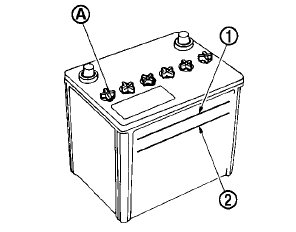
Check the fluid level in each cell. (Remove the battery cover if it is necessary.) It should be between the UPPER LEVEL 1 and LOWER LEVEL2 lines.
If it is necessary to add fluid, add only distilled water to bring the level to the indicator in each filler opening. Do not overfill.
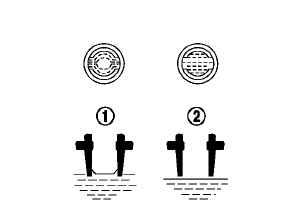
1. Remove the cell plugs A .
2. Add distilled water up to the UPPER LEVEL
1 line.
If the side of the battery is not clear, check the distilled water level by looking directly above the cell; the condition 1 indicates OK and the conditions 2 needs more to be added.
3. Tighten cell plugs A .
Vehicles operated in high temperatures or under severe conditions require frequent checks of the battery fluid level.
JUMP STARTING
If jump starting is necessary, see “Jump starting” in the “6. In case of emergency” section. If the engine does not start by jump starting, the battery may have to be replaced. Contact a NISSAN dealer.
See also:
Drinking alcohol/drugs and driving
WARNING
Never drive under the influence of
alcohol or drugs. Alcohol in the bloodstream
reduces coordination, delays
reaction time and impairs judgement.
Driving after drinking alcohol increase ...
Vehicle Dynamic Control (VDC) system
The Vehicle Dynamic Control (VDC) system uses
various sensors to monitor driver inputs and vehicle
motion. Under certain driving conditions,
the VDC System helps to perform the following
functions ...
Car phone or CB radio
When installing a CB, ham radio or car phone in
your vehicle, be sure to observe the following
precautions; otherwise, the new equipment may
adversely affect the engine control system and
other el ...