
Capacities and recommended fuel/lubricants
The following are approximate capacities. The actual refill capacities may be a little different. When refilling, follow the procedure instructed in the “8. Maintenance and do-it-yourself” section to determine the proper refill capacity.
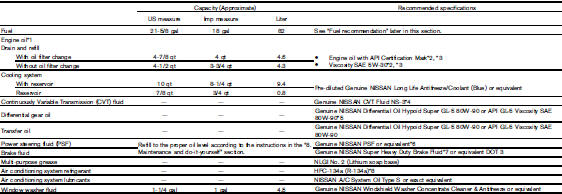
1: For additional information, see “Engine oil” in the “8. Maintenance and
do-it-yourself” section for changing engine oil.
2: For additional information, see “Engine oil and oil filter recommendation”
later in this section.
3: NISSAN recommends Genuine NISSAN Ester Engine Oil available at a NISSAN
dealer.
4: Use only Genuine NISSAN CVT Fluid NS-3. Using transmission fluid other
than Genuine NISSAN CVT Fluid NS-3 will damage the CVT, which is not covered by
the NISSAN new vehicle
limited warranty.
5: For hot climates, viscosity SAE 90 is suitable for ambient temperatures above
328F (08C).
6: DEXRONTM VI type ATF may also be used.
7: Available in mainland U.S.A. through a NISSAN dealer.
8: For additional information, see “Vehicle identification” later in this
section for air conditioner specification label.
- Fuel recommendation
- Engine oil and oil filter recommendation
- Air conditioning system refrigerant and lubricant recommendations
See also:
Push-button ignition switch positions
LOCK (Normal parking position)
The ignition switch can only be locked in this
position.
The ignition switch will be unlocked when it is
pushed to the ACC position while carrying the
Intelligent ...
Installing top tether strap (3rd row bench seat)
1. Top tether strap
2. Anchor point
WARNING
In the 3rd row bench seat, a child restraint
with a top tether strap can only be used on
the passenger side seating position. Do
not place in the dr ...
Cruise control
1. ACCEL/RES switch
2. COAST/SET switch
3. CANCEL switch
4. ON·OFF switch ...