
Three-point type seat belt with retractor
Basic Information
WARNING
- Every person who drives or rides in this vehicle should wear a seat belt at all times. Children should ride in the rear seats and must be secured in an appropriate restraint that matches their size and age.
- Do not ride in a moving vehicle with the seatback reclined. This position can be dangerous because the
shoulder belt will not rest properly against your body. In an accident, you could be thrown into the
belt and suffer neck or other serious injuries.
You could also slide under the lap belt, which can cause serious internal injuries.
- For the most effective protection while the vehicle is moving, the seat should be in an upright position. Always sit well back and upright in the seat with both feet on the floor, and adjust the seat belt so it fits securely and correctly across your body.
- Do not allow children to play with the seat belts. Most seating positions are equipped with Automatic
Locking Retractor (ALR) mode seat belts. If a seat belt becomes wrapped around a child's neck while ALR
mode is activated, the belt can retract and tighten, which could seriously injure or kill the child.
This can happen even when the vehicle is parked.
Unbuckle the seat belt immediately to release the child. If the seat belt cannot be unbuckled, or if it is already unbuckled but remains tight, release the child by cutting the seat belt with a suitable tool, such as a knife or scissors.
Fastening the seat belts
1. Adjust the seat before fastening the belt. In the Nissan Murano, the seat should be positioned so you can sit upright, reach the controls comfortably, and allow the belt to route naturally across the shoulder, chest, and hips.
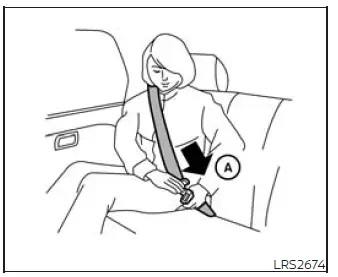
2. Slowly pull the seat belt out of the retractor and insert the tongue into the buckle A until you hear and feel the latch engage. A secure click confirms that the tongue is seated in the buckle and that the belt is ready to be positioned correctly.
- The retractor is designed to lock during a sudden stop or on impact.
A slow, steady pulling motion allows the seat belt to extend smoothly and gives the occupant some normal freedom of movement while seated.
- If the seat belt cannot be pulled from its fully retracted position, firmly pull the belt once and release
it.
Then pull the belt out smoothly from the retractor, making sure it is not twisted or caught before fastening it.
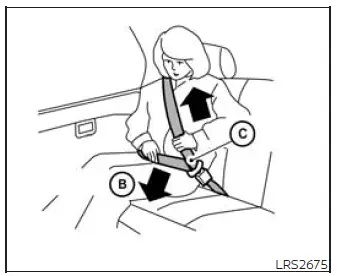
3. Position the lap belt portion low and snug on the hips B as shown. The lap belt should sit around the hips, not across the waist, so it can help restrain the body more effectively in a collision.
4. Pull the shoulder belt portion toward the retractor to remove extra slack C. Make sure the shoulder belt is routed over your shoulder and across your chest, away from your neck but not slipping off your shoulder.
The front passenger seat and the rear seating positions' three-point seat belts in the Nissan Murano have two modes of operation:
- Emergency Locking Retractor (ELR), used during normal seating and driving conditions while allowing controlled belt movement.
- Automatic Locking Retractor (ALR), used when the belt is placed into a locked mode for certain restraint situations.
The ELR mode allows the seat belt to extend and retract so the driver and passengers have some freedom of movement in the seat. The ELR locks the seat belt when the vehicle slows rapidly or during certain impacts, helping the restraint system hold the occupant more securely when sudden force is detected.
The ALR mode, also known as child restraint mode, locks the seat belt so it can help secure a compatible child restraint during installation.
When ALR mode is activated, the seat belt cannot be pulled out farther until the seat belt tongue is released from the buckle and the belt is allowed to retract completely. After the belt has fully retracted, the system returns to ELR mode for normal occupant use.
ALR mode should be used only for child restraint installation. During normal seat belt use by an occupant, ALR mode should not be activated. If it is activated during regular seating, it may create uncomfortable seat belt tension. It can also affect the operation of the front passenger air bag system in the Nissan Murano.
WARNING When fastening the seat belts, always confirm that the seatbacks are fully secured in the latched position. If a seatback is not completely locked, passengers may be injured during a sudden stop or accident.
Unfastening the seat belts
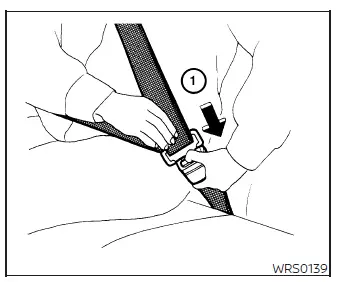
To unfasten the seat belt, press the button on the buckle 1. After the tongue is released, guide the belt as it retracts so it returns smoothly and does not twist, strike trim, or remain caught near the seat.
Checking seat belt operation
Seat belt retractors are designed to lock seat belt movement in two separate situations:
- When the seat belt is pulled quickly from the retractor.
- When the vehicle slows down rapidly.
To increase your confidence that the seat belts are operating as intended, check the retractor function as follows:
- Grasp the shoulder belt and pull it forward quickly. The retractor should lock immediately and restrict additional belt movement.
If the retractor does not lock during this check, have the system inspected. It is recommended that you visit a NISSAN dealer for this service, or for more information about correct seat belt operation in the Nissan Murano.
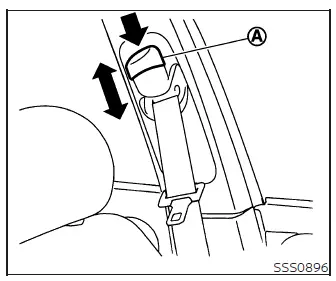
Shoulder belt height adjust button
Shoulder belt height adjustment (front seats)
The shoulder belt anchor height should be adjusted to the position that fits the occupant best. Correct height helps the shoulder belt lie across the proper area of the body instead of resting too close to the neck or slipping off the shoulder.
To adjust the shoulder belt anchor, press the button A and move the anchor to the desired position. Set it so the belt passes over the center of the shoulder. The belt should stay away from your face and neck, but it should not fall off your shoulder. Release the adjustment button to lock the shoulder belt anchor into position before driving.
WARNING
- After adjustment, release the adjustment button and try to move the shoulder belt anchor up and down to make sure it is securely fixed in position.
- The shoulder belt anchor height should be adjusted to the position that fits you best. Failure to do so may reduce the effectiveness of the entire restraint system and increase the chance or severity of injury in an accident.
- The shoulder belt should rest on the middle of the shoulder. It must not rest against the neck.
- Be sure that the seat belt is not twisted in any way. A twisted belt may not sit flat against the body and may not work as effectively during a sudden stop or collision.
- Be sure that the shoulder belt anchor is secured by trying to move the shoulder belt anchor up and down after adjustment. Do not use the seating position in the Nissan Murano until the anchor is locked firmly in place.
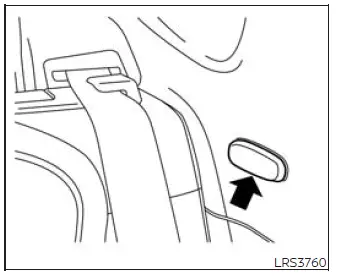
Seat belt hook
When the seat belt is not being used, and especially when folding the rear seats, place the rear seat belts on the seat belt hooks. This helps keep the belts out of the folding path, reduces the chance of the webbing becoming twisted or trapped, and keeps the rear seating area organized when the cargo space is being expanded.
Seat belt extenders
If body size or driving position prevents the lap/shoulder belt from fitting correctly and fastening securely, a compatible seat belt extender is available for purchase. The extender adds approximately 8 in (200 mm) of length and is intended only for seating positions where the standard belt cannot be used properly without additional length. For the Nissan Murano, the extender is available for the:
- Driver and front passenger seating positions.
It is recommended that you visit a NISSAN dealer for assistance with purchasing the correct extender if one is required. The extender must match the installed seat belt system and should only be used for the seating position and occupant for which it is needed.
WARNING
- Only NISSAN seat belt extenders made by the same company that produced the original equipment seat belts should be used with NISSAN seat belts. Using an extender that is not designed for the vehicle's belt system may affect belt fit and restraint performance.
- Adults and children who can use the standard seat belt correctly should not use an extender. Unnecessary use of an extender can change how the belt fits across the body and may result in serious personal injury during an accident.
- Never use seat belt extenders to install child restraints. If a child restraint is not secured properly with the vehicle's seat belt system, the child could be seriously injured or killed in a collision or sudden stop.
Seat belt maintenance
- To clean the seat belt webbing, apply a mild soap solution or a cleaner recommended for upholstery or carpet. Wipe the webbing with a clean cloth and allow the seat belts to dry in the shade. Do not allow the belts to retract until they are completely dry, because damp webbing can retract poorly and may retain moisture inside the retractor area.
- If dirt builds up in the shoulder belt guide at the seat belt anchor, the belt may retract slowly or unevenly. Wipe the shoulder belt guide with a clean, dry cloth so the webbing can move through the guide more freely.
- Periodically check that the seat belt and its metal components, including buckles, tongues, retractors, flexible wires, and anchors, operate properly. If loose parts, deterioration, cuts, fraying, or any other damage is found on the webbing or hardware, the entire seat belt assembly should be replaced. Proper seat belt condition is essential for occupant protection in the Nissan Murano.
See also:
Heated rear seat switches. Heated steering wheel switch. Steering Assist switch (for vehicles with
ProPILOT Assist)
Heated rear seat switches
WARNING Do not use or allow occupants to use the rear seat heater if you or the occupants
cannot monitor increased seat temperature, cannot respond to excessive heat, ...
Cigarette lighter and ashtray (if so equipped)
To open the ashtray lid, push the lid down and
release it1 .
To empty the ashtray, pull out2 .
The cigarette lighter operates when the ignition
switch is in the ON position.
Push the ligh ...
Entry/exit function (for Hardtop models)
This system is designed so that the driver’s seat
and steering column will automatically move
when the shift lever is in the P (Park) position.
This allows the driver to get into and out of the ...