
Precautions on child restraints
WARNING
- Failure to follow the warnings and instructions for proper child restraint selection, use, and
installation could result in serious injury or death to a child or other passengers during a sudden stop
or collision:
- The child restraint must be used and installed correctly every time it is placed in the vehicle. Always follow all instructions provided by the child restraint manufacturer for installation, belt routing, harness adjustment, and daily use.
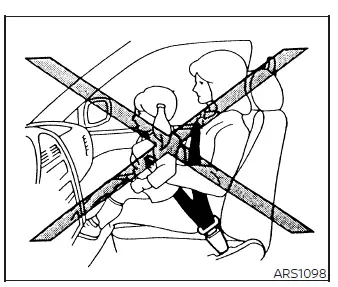
- Infants and children should never be held on anyone's lap while the vehicle is moving. Even the strongest adult cannot hold a child securely against the forces created in a collision or abrupt stop.
- Do not place one seat belt around both a child and another passenger. A seat belt is designed to restrain one occupant at a time and may not protect either person correctly if shared.
- NISSAN recommends that all child restraints be installed in the rear seat. Studies show that children are safer when properly restrained in the rear seat than in the front seat. If a forward-facing child restraint must be installed in the front seat, see "Forward-facing child restraint installation using the seat belts" and follow the required procedure carefully.
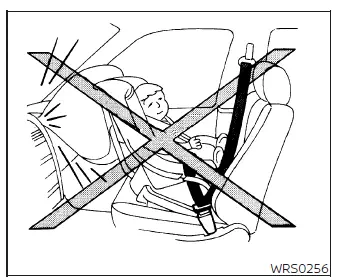
- Even with the NISSAN Advanced Air Bag System, never install a rear-facing child restraint in the front seat. An inflating air bag could seriously injure or kill a child. A rear-facing child restraint must only be used in the rear seat of the Nissan Murano.
- Be sure to purchase a child restraint that fits both the child and the vehicle. Some child restraints may not fit properly in certain seating positions, even when they are approved for general use.
- Child restraint anchorages are designed to withstand only the loads applied by correctly fitted
child restraints. Under no circumstances should they be used to attach adult seat belts, cargo
straps, equipment, or other items to the vehicle.
Using the anchorages incorrectly could damage them. If the anchorage is damaged, the child restraint may not be installed securely, and a child could be seriously injured or killed in a collision.
- Never use the child restraint anchor points for adult seat belts, cargo tie-downs, accessories, or any other items.
- A child restraint with a top tether strap should not be used in the front passenger seat.
- Keep seatbacks as upright as possible after fitting the child restraint so the restraint can sit firmly against the vehicle seat as intended.
- Infants and children should always be placed in an appropriate child restraint while riding in the vehicle.
- When the child restraint is not being used, keep it secured with the LATCH system or with a seat belt. In a sudden stop or collision, an unsecured child restraint can move through the cabin, injure occupants, or damage the vehicle interior.
CAUTION A child restraint left inside a closed vehicle can become very hot. Before placing a child in the restraint, check the seating surface, harness, buckles, and nearby trim so the child is not burned or made uncomfortable.
This vehicle is equipped with a universal child restraint anchor system known as LATCH, which stands for Lower Anchors and Tethers for CHildren. Some child restraints include rigid attachments or webbing-mounted connectors that can be attached directly to these lower anchors, depending on the restraint design and the seating position.
If you do not have a LATCH-compatible child restraint, the vehicle seat belts can be used to secure the restraint. In the Nissan Murano, the correct installation method depends on the child restraint design, the selected seating position, and the instructions supplied by the restraint manufacturer.
Several manufacturers offer child restraints for infants and children of different sizes. When selecting any child restraint, consider the following points carefully before installation:
- Choose only a restraint with a label certifying that it complies with Federal Motor Vehicle Safety Standard 213 or Canadian Motor Vehicle Safety Standard 213.
- Check the child restraint in your vehicle to confirm that it is compatible with the vehicle seat shape, seating position, and seat belt system.
- If the child restraint is compatible with your vehicle, place your child in the restraint and check the available adjustments to make sure the restraint fits the child correctly. Choose a child restraint designed for the child's height and weight, and always follow all recommended procedures from the manufacturer.
- If the combined weight of the child and child restraint is less than 65 lbs. (29.5 kg), you may use either the LATCH anchors or the seat belt to install the child restraint, but do not use both at the same time.
- If the combined weight of the child and child restraint is greater than 65 lbs.
(29.5 kg), use the vehicle's seat belt, not the lower anchors, to install the child restraint.
- Be sure to follow the child restraint manufacturer's instructions for installation, tightening, angle adjustment, tether use, and final movement checks.
All U.S. states and Canadian provinces or territories require that infants and small children be restrained in an approved child restraint whenever the vehicle is being operated. Canadian law requires the top tether strap on forward-facing child restraints to be secured to the designated anchor point on the vehicle. For the Nissan Murano, correct restraint use means matching the child restraint to the child, the seating position, and the approved installation method before every trip.
See also:
Starting the engine
1. Apply the parking brake.
2. Move the shift lever to the P (Park) or N
(Neutral) position. (P is recommended.)
The starter is designed not to operate unless
the shift lever is in either of the a ...
Care and maintenance
Use a lightly dampened, lint free cloth to clean the
surfaces of your Dual Head Restraint DVD System
(DVD player face, screen, remote controller,
etc.).
CAUTION
● Do not use any solvents or ...
Hazard warning flasher switch
Push the switch on to warn other drivers when
you must stop or park under emergency conditions.
All turn signal lights will flash.
WARNING
• If stopping for an emergency, be
sure to move th ...