
I-FCW system limitations
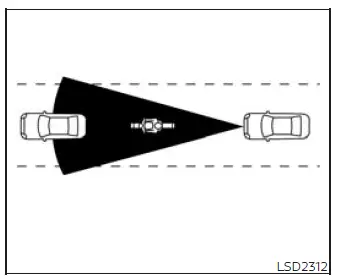
Illustration
A
WARNING The limitations of the I-FCW system are described below. The driver must understand these limitations and operate the vehicle accordingly. Failure to maintain control of the vehicle or to account for conditions in which the system may not detect traffic ahead could result in a collision, serious injury or death.
- The I-FCW system cannot detect every vehicle or provide a warning under all road, traffic, visibility and weather conditions. The driver remains responsible for observing the road ahead and responding to hazards.
- The radar sensor is not designed to detect the following objects or road users:
- Pedestrians, animals or stationary obstacles in the roadway
- Oncoming vehicles approaching from the opposite direction
- Vehicles crossing the Nissan Murano’s direction of travel
- As shown in Illustration A, the I-FCW system may not function when the vehicle ahead has a narrow profile, such as a motorcycle. A narrow vehicle may not remain within the radar sensor’s effective detection area.
- The radar sensor may be unable to detect a vehicle ahead, or detection may be delayed, under the
following conditions:
- Driving in snow or heavy rain that reduces the sensor’s ability to monitor traffic ahead
- Dirt, ice, snow or another material covering or obstructing the radar sensor area
- Interference from other radar sources operating near the vehicle
- Snow, water or road spray produced by surrounding vehicles
- Driving through a tunnel, where surrounding structures may affect radar operation
- As shown in Illustration B, the system may not correctly detect a vehicle ahead when that vehicle is being towed. The shape, position or movement of the towed vehicle may prevent reliable radar recognition.
- As shown in Illustration C, when the distance to the vehicle ahead is extremely short, that vehicle may obstruct the radar sensor beam and prevent the system from monitoring another vehicle farther ahead.
- As shown in Illustration D, I-FCW performance may be limited while driving down a steep slope or along a road with sharp curves. The direction of the radar beam may temporarily prevent the system from detecting a vehicle ahead.
- The system is designed to check radar sensor operation automatically, but this self-check has limitations. Certain obstructions, including ice, snow, dirt, stickers or similar materials covering the sensor area, may not always be recognized. Under these conditions, the I-FCW system may not provide a warning when one is needed. Inspect the sensor area regularly and keep it clean, clear and free of anything that could interfere with radar operation.
- Excessive sound inside or around the vehicle may make the warning chime difficult or impossible to hear. Do not rely solely on the audible alert to recognize a potential collision risk.
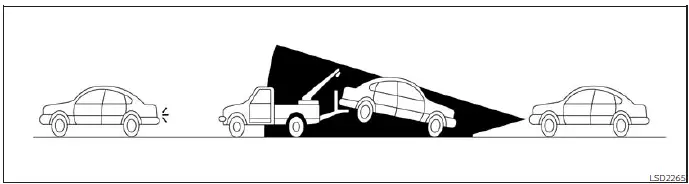
Illustration B
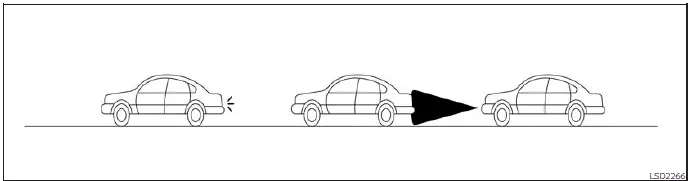
Illustration C
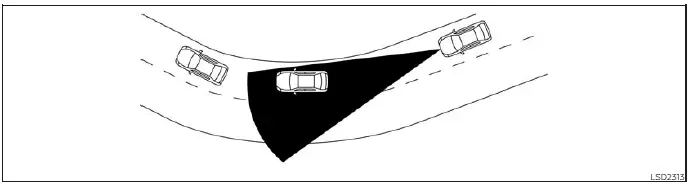
Illustration D
See also:
Driving safety precautions
Your NISSAN is designed for both normal and
off-road use. However, avoid driving in deep
water or mud as your NISSAN is mainly
designed for leisure use, unlike a conventional
off-road vehicle.
...
Seat belts with pretensioners (front seats)
WARNING
• The
pretensioners cannot be reused
after activation. They must be replaced together with the retractor
and buckle as a unit.
• If the vehicle
becomes involved in a
collision but ...
Air bags, seat belts and child restraints. Exterior front. Exterior rear
Air bags, seat belts and child restraints
Roof-mounted curtain side-impact and rollover supplemental air bags, positioned along the upper side areas
of the cabin to help provide addi ...