
Jump starting
To start the Nissan Murano using a booster battery, follow every instruction and safety precaution below in the specified order. Incorrect cable placement or improper handling of either battery can cause serious injury and may damage the vehicle's electrical or charging system.
WARNING
- Incorrect jump-starting procedures can cause a battery to explode, resulting in severe personal injury or death. Improper connections may also damage the vehicle and its electrical components.
- Explosive hydrogen gas is always present near the battery. Keep sparks, open flames, smoking materials, and other possible ignition sources away from the battery at all times.
- Do not allow battery fluid to contact your eyes, skin, clothing, or painted vehicle surfaces. Battery fluid contains corrosive sulfuric acid that can cause severe burns and surface damage. If contact occurs, immediately flush the affected area thoroughly with water.
- Keep the battery and all jump-starting equipment out of the reach of children.
- The booster battery must have a 12-volt rating. Using a battery with an incorrect voltage may damage the Nissan Murano and its electrical system.
- Whenever working on or near a battery, wear suitable eye protection, such as safety goggles or industrial safety glasses. Remove rings, metal watchbands, bracelets, and other jewelry before handling the jumper cables. Never lean directly over the battery while jump starting.
- Do not attempt to jump-start a frozen battery. A frozen battery may explode and cause serious personal injury.
- The vehicle is equipped with an automatic engine cooling fan that may begin operating at any time. Keep your hands, clothing, tools, jumper cables, and other objects away from the fan and surrounding moving parts.
WARNING Always follow the connection procedure below exactly as described.
Failure to connect or disconnect the jumper cables correctly may damage the charging system and could result in serious personal injury.
1. If the booster battery is installed in another vehicle, position the two vehicles close enough for the jumper cables to reach both connection points without being stretched.
Do not allow the two vehicles to touch each other.
2. Apply the parking brake securely. Press the park button to place the Nissan Murano in the P (Park) position.
Switch off all unnecessary electrical equipment, including the lights, heater, air conditioner, and other accessories, to reduce the electrical load during the jump-starting procedure.
3. Place the ignition switch in the LOCK or OFF position before connecting the jumper cables.
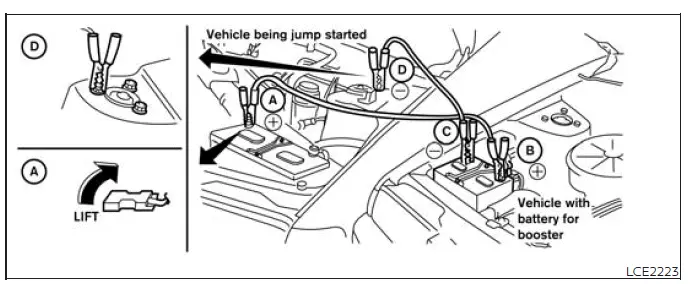
4. Connect the jumper cables in the exact sequence shown in the illustration ( A , B , C , D ). Confirm that every clamp is firmly attached before proceeding to the next connection.
CAUTION
- Always connect the positive (+) terminal to the positive (+) terminal. Connect the negative (−) cable to a suitable body ground, such as a strut mounting bolt or engine lifting bracket, rather than directly to the discharged battery.
- Route the jumper cables so they cannot contact the cooling fan, belts, or any other moving parts inside the engine compartment. Make sure the cable clamps do not touch unintended metal surfaces or each other.
5. Start the engine of the booster vehicle and allow it to run for several minutes.
6. Maintain the booster vehicle's engine speed at approximately 2,000 rpm, then attempt to start the engine of the Nissan Murano.
CAUTION Do not operate the starter motor continuously for more than 10 seconds. If the engine does not start immediately, place the ignition switch in the OFF position and wait 3 to 4 seconds before making another attempt.
7. After the engine starts, carefully disconnect the jumper cables in reverse order, removing the negative cable first and then the positive cable. Keep the disconnected clamps separated and away from moving engine components.
Push starting
CAUTION Nissan Murano models equipped with an automatic transmission cannot be started by pushing or towing the vehicle. Attempting to push-start the vehicle may damage the transmission.
See also:
Rear window and outside mirror defroster switch. Windshield Deicer
Rear window and outside mirror defroster switch
To defrost the rear window glass and outside mirrors, place the ignition switch in the ON position and push the
rear window defroster switch on. P ...
Precautions when starting and driving
WARNING
• Do not leave children or adults who
would normally require the support
of others alone in your vehicle. Pets
should not be left alone either. They
could accidentally injure themselves ...
Horn
To sound the horn, push near the horn icon of the
steering wheel.
WARNING
Do not disassemble the horn. Doing so
could affect proper operation of the
supplemental front air bag system. Tampering ...