
Tire labeling
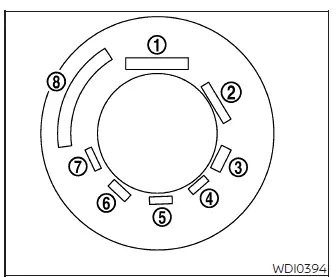
Example
Basic information
Federal law requires tire manufacturers to place standardized identification and specification information on the sidewall of every tire. These markings allow vehicle owners, technicians, and tire retailers to identify the tire’s construction, dimensions, operating limits, and manufacturing details.
This information describes the tire’s fundamental characteristics and includes the Tire Identification Number (TIN), which confirms compliance with applicable safety certification requirements. The TIN can also be used to identify a specific tire if the manufacturer or a regulatory authority announces a safety recall. Understanding these markings makes it easier to select tires that match the requirements of the Nissan Murano.
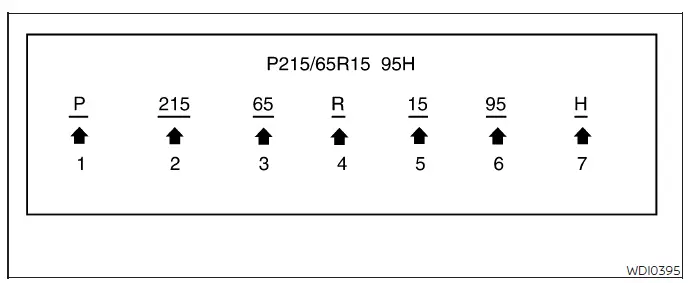
Example
- Tire size (example: P215/65R15 95H)
1. P: The letter “P” indicates that the tire is designed primarily for use on passenger vehicles. Some tire size designations do not include this letter, so its absence does not necessarily mean that the tire is unsuitable for passenger-vehicle use.
2. Three-digit number (215): This number identifies the tire width in millimeters, measured from one sidewall edge to the opposite sidewall edge. It represents the nominal section width of the tire.
3. Two-digit number (65): This number is the tire’s aspect ratio. It expresses the sidewall height as a percentage of the tire width and helps describe the tire’s overall profile.
4. R: The letter “R” indicates that the tire uses radial construction. In a radial tire, the internal cord layers are arranged in a radial pattern.
5. Two-digit number (15): This number specifies the diameter of the wheel or rim, measured in inches, on which the tire is designed to be installed.
6. Two- or three-digit number (95): This number is the tire’s load index. It corresponds to the maximum amount of weight that each properly inflated tire is designed to support.
7. H: This letter indicates the tire’s speed rating. The vehicle should not be driven at a speed greater than the rating specified for the installed tires. Replacement tires for the Nissan Murano should meet the applicable load and speed requirements.
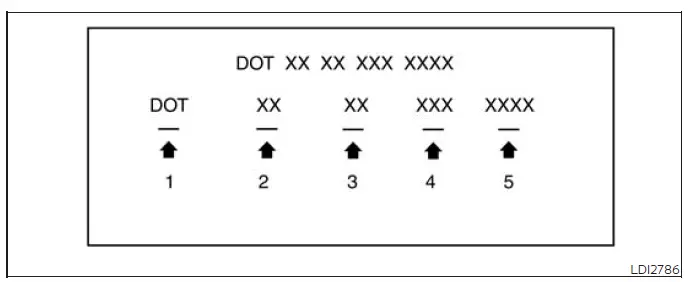
Example (Type A) (if so equipped)
- TIN (Tire Identification Number) for a new tire (example: DOT XX XX XXX XXXX)
1. DOT: This is the abbreviation for the “Department Of Transportation.” The DOT symbol may appear above, below, to the left, or to the right of the Tire Identification Number, depending on the layout of the tire sidewall.
2. Two-digit code: This code is the tire manufacturer’s identification mark and identifies the manufacturing facility associated with the tire.
3. Two-digit code: This portion of the TIN identifies the tire size.
4. Three-digit code: This optional code identifies the tire type or other characteristics assigned by the manufacturer.
5. Four numbers indicate the week and year in which the tire was manufactured. The first two digits identify the production week, while the final two digits identify the production year.
For example, the number 3103 indicates that the tire was manufactured during the 31st week of 2003. If the date code is not visible on the sidewall being inspected, check the opposite sidewall of the tire.
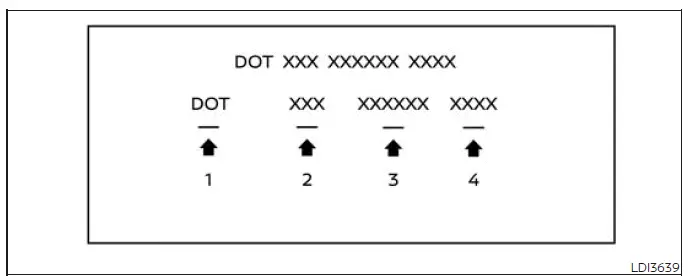
Example (Type B) (if so equipped)
- TIN (Tire Identification Number) for a new tire (example: DOT XXX XXXXXX XXXX)
1. DOT: This is the abbreviation for the “Department Of Transportation.” The symbol may be positioned above, below, to the left, or to the right of the Tire Identification Number, depending on the tire manufacturer’s sidewall design.
2. Three-digit code: This code is the manufacturer’s identification mark and identifies the facility where the tire was produced.
3. Six-digit code: This descriptive code is used to identify significant characteristics of the tire as assigned by the manufacturer.
4. Four numbers identify the week and year in which the tire was manufactured. The first pair of digits represents the production week, and the second pair represents the year.
For example, the number 3103 indicates that the tire was manufactured during the 31st week of 2003. This date information can help determine tire age when inspecting or replacing tires on the Nissan Murano.
- Tire ply composition and material
This marking identifies the number of layers, or plies, of rubber-coated fabric used in the tire’s construction. Tire manufacturers must also identify the primary materials used in those layers, which may include steel, nylon, polyester, or other materials. The listed composition can differ between the tread and sidewall areas.
- Maximum permissible inflation pressure
This number indicates the greatest air pressure that may be placed in the tire. Do not exceed the maximum permissible inflation pressure shown on the sidewall. This figure is a tire limit and should not be used as a substitute for the recommended cold tire pressure listed on the vehicle’s Tire and Loading Information label.
- Maximum load rating
This number identifies the maximum load, expressed in kilograms and pounds, that the tire is designed to carry under the specified conditions. When replacing tires on the vehicle, use tires with the same load rating as the factory-installed tires or a rating that meets the applicable vehicle requirements.
- Term of “tubeless” or “tube type”
This marking indicates whether the tire is designed to operate without an inner tube, identified as “tubeless,” or whether it requires a separate inner tube, identified as “tube type.”
- The word “radial”
The word “radial” appears on the sidewall when the tire has radial construction. This marking confirms the basic internal construction type of the tire.
- Manufacturer or brand name
The tire manufacturer’s name or brand name is displayed on the sidewall so the tire can be identified by its producer or marketed product line.
Other Tire-related Terminology
In addition to the terms defined throughout this section, the Intended Outboard Sidewall refers to either: (1) the sidewall that contains a whitewall, displays white lettering, or carries manufacturer, brand, and/or model-name molding that is raised higher or recessed deeper than the same molding on the opposite sidewall; or (2) the sidewall of an asymmetrical tire that is specifically designed to face outward when the tire is mounted on the vehicle. A tire with a designated outward-facing side must be installed in the correct orientation to match its intended design and application on the Nissan Murano.
See also:
Headlight control switch
Basic Information
Type A (if so equipped)
Type B (if so equipped)
Lighting
Rotate the switch to the position, and the front parking, tail, license plate, and
instrument panel lights w ...
Maintenance requirements
Your NISSAN has been designed to have minimum
maintenance requirements with long service
intervals to save you both time and money.
However, some day-to-day and regular maintenance
is essential ...