
Maximum load limits
Maximum trailer loads
Never allow the total trailer load to exceed the maximum value listed in the "Towing Load/Specification" chart provided in this section. The applicable limit must be observed whenever the Nissan Murano is used to tow a trailer.
The total trailer load is the combined weight of the trailer itself and everything carried on or inside it. Cargo, equipment, and other items added to the trailer must therefore be included when calculating the complete towing load.
The Gross Combined Weight Rating (GCWR) must not exceed the maximum value specified in the following Towing Load/Specification Chart. Confirm the combined vehicle and trailer weight before towing, particularly when carrying several passengers or a substantial amount of cargo.
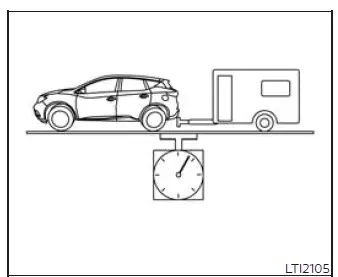
The Gross Combined Weight Rating (GCWR) is the combined weight of the towing vehicle, including the driver, passengers, cargo, and installed equipment, plus the total loaded weight of the trailer. Exceeding the listed ratings or using unsuitable towing equipment may adversely affect Nissan Murano handling, braking, stability, and overall performance.
The ability of the vehicle to tow safely depends not only on the maximum trailer rating but also on the route, surface conditions, and environment in which the towing will take place.
A trailer weight that may be suitable for level highway travel may need to be reduced in areas with limited traction. Slippery boat ramps and similar surfaces can make it more difficult for the vehicle to start moving, maintain control, or stop safely while towing.
Outside temperature and road grade can also affect towing performance. Pulling a heavy trailer in high ambient temperatures or on steep roads may increase the load on the engine and contribute to overheating. If necessary, the engine protection mode may activate to help reduce the possibility of engine damage by automatically lowering engine power. Vehicle speed may also decrease under a heavy load. Plan the journey with the total vehicle and trailer weight, expected weather, road gradients, and surface conditions in mind.
WARNING Engine overheating may reduce available power and cause vehicle speed to decrease. The resulting speed may be lower than the surrounding traffic flow, increasing the risk of a collision. Drive with particular care under demanding towing conditions. If the Nissan Murano cannot maintain a safe speed, move off the roadway and stop in a safe location. Allow the engine to cool and return to normal operation before continuing.
CAUTION Damage to the vehicle caused by improper towing practices or failure to follow the specified towing limits is not covered by NISSAN warranties.
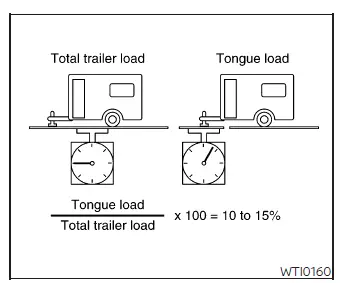
Tongue load
When using either a weight-carrying hitch or a weight-distributing hitch, maintain the tongue load between 10% and 15% of the total trailer load, unless the trailer manufacturer specifies a different required tongue load. The actual tongue load must also remain within the maximum limit shown in the following "Towing Load/Specification" chart. If the measured tongue load is too high, redistribute the trailer cargo until the load is correctly balanced and falls within the permitted range.
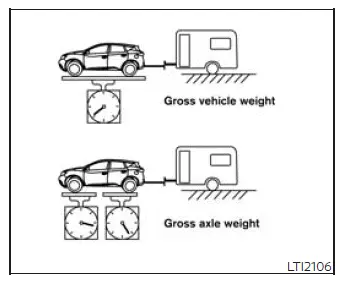
Maximum Gross Vehicle Weight (GVW)/maximum Gross Axle Weight (GAW)
The Gross Vehicle Weight (GVW) of the towing vehicle must never exceed the Gross Vehicle Weight Rating (GVWR) listed on the F.M.V.S.S./C.M.V.S.S. certification label.
GVW is the combined weight of the unloaded Nissan Murano, all passengers, luggage and cargo, the trailer hitch, trailer tongue load, and any other optional equipment installed on the vehicle. In addition to remaining within the GVWR, the weight carried by the front or rear axle must not exceed the corresponding Gross Axle Weight Rating (GAWR) shown on the F.M.V.S.S./C.M.V.S.S. certification label.
Towing capacities are calculated for a base vehicle carrying the driver and any equipment required to achieve the stated rating. The weight of additional passengers, cargo, accessories, and optional equipment, including the trailer hitch, reduces the remaining towing capacity and the amount of trailer tongue load the vehicle can safely support.
The loaded vehicle and trailer should be weighed to verify compliance with the GVWR, front GAWR, rear GAWR, Gross Combined Weight Rating (GCWR), and maximum towing capacity. Each of these limits must be satisfied at the same time.
Vehicle and trailer weights can be measured on platform-type scales commonly available at truck stops, highway weigh stations, building supply centers, or salvage yards. Weigh the Nissan Murano and trailer in the same loaded condition in which they will normally be operated.
Use the following procedure to calculate the payload capacity available for trailer tongue or king pin load.
1. Locate the GVWR specified on the F.M.V.S.S./C.M.V.S.S. certification label.
2. Weigh the vehicle with all passengers, cargo, accessories, and equipment that will normally be carried while towing the trailer.
3. Subtract the actual loaded vehicle weight from the GVWR. The remaining amount represents the maximum payload capacity available for the tongue or king pin load. The applicable axle ratings and other towing limits must still not be exceeded.
Use the following procedure to calculate the available towing capacity.
1. Find the GCWR applicable to your vehicle in the "Towing Load/Specification" chart provided in this section.
2. Subtract the actual loaded vehicle weight from the GCWR. The remaining amount is the maximum towing capacity available under those loading conditions.
To determine the Gross Trailer Weight, place the fully loaded trailer on a suitable scale with all equipment, luggage, and cargo normally carried during towing. Confirm that the measured trailer weight does not exceed the Gross Trailer Weight Rating specified for the trailer or the available maximum towing capacity calculated for the vehicle.
Weigh the front and rear axles separately to confirm that the measured Front Gross Axle Weight and Rear Gross Axle Weight remain within the corresponding front and rear GAWR values listed on the F.M.V.S.S./C.M.V.S.S. certification label. If the Nissan Murano, either axle, or the trailer exceeds an applicable rating, redistribute or remove passengers, cargo, equipment, or trailer contents until every specified weight limit is met.
Example:
- Gross Vehicle Weight (GVW) measured on a scale, including the driver, passengers, cargo, and installed hitch: 6,350 lbs. (2,880 kg).
- Gross Vehicle Weight Rating (GVWR) listed on the F.M.V.S.S./C.M.V.S.S. certification label: 7,250 lbs. (3,289 kg).
- Gross Combined Weight Rating (GCWR) shown in the "Towing Load/Specification" chart: 15,100 lbs. (6,849 kg).
- Maximum trailer towing capacity listed in the "Towing Load/Specification" chart: 9,100 lbs. (4,128 kg).
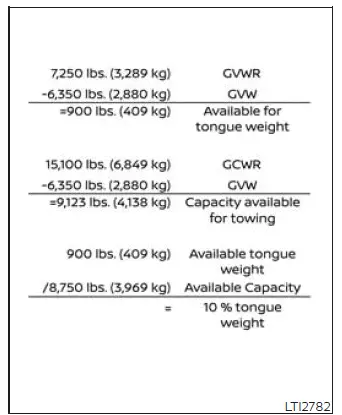
The available towing capacity may be lower than the maximum published towing capacity because the weight of passengers, cargo, the hitch, and other equipment carried by the Nissan Murano reduces the amount of capacity remaining for the loaded trailer. Use the vehicle's actual loaded weight when making this calculation.
Maintain the trailer tongue weight between 10% and 15% of the total loaded trailer weight, unless the trailer manufacturer specifies a different tongue load requirement. The selected tongue load must also remain within every applicable vehicle, hitch, and trailer rating.
If the tongue load is excessive, reposition the trailer cargo to achieve the proper load distribution. Never exceed the maximum tongue weight shown in the "Towing Load/Specification" chart, even when the calculated available payload would permit a tongue weight greater than 15% of the trailer weight. If the available tongue weight is less than 10% of the total trailer weight, reduce the trailer load until the required tongue weight can be maintained without exceeding the Nissan Murano limits.
Always verify the final vehicle weight, axle loads, trailer weight, combined weight, and tongue load to confirm that each measured value remains within its corresponding rating. Meeting one limit does not permit any other listed rating to be exceeded.
Trailer frontal area
CAUTION Exceeding the maximum permitted trailer frontal area can place greater aerodynamic load on the vehicle than its towing specifications allow. This may reduce towing performance and could result in vehicle damage.
Trailer frontal area influences the amount of air resistance encountered while towing. It represents the total forward-facing area of the vehicle-and-trailer combination that is exposed to airflow. Do not exceed the maximum trailer frontal area specified in the "Towing Load/Specification" chart for the Nissan Murano.
To estimate the trailer frontal area, multiply the trailer's overall width by its overall height. For example, a trailer measuring 8 feet wide and 6 feet high has a frontal area of 48 square feet. This calculation should be considered together with the trailer weight and all other towing limits.
See also:
Lights
Basic information
Headlight assembly
Map lights
Door mirror turn signal lights (if so equipped)
Personal lights
Front combination light assembly
High-mounted stop light
...
Voice adaptation mode
The Voice Adaptation mode allows up to two
users with different dialects to train the system
to improve recognition accuracy. By repeating a
number of commands, the users can create a
voice model ...
Lift gate (Hardtop models)
WARNING
• Always be sure the lift gate has
been closed securely to prevent it
from opening while driving.
• Do not drive with the lift gate open.
This could allow dangerous exhaust
gases t ...