
Precautions on seat belt usage
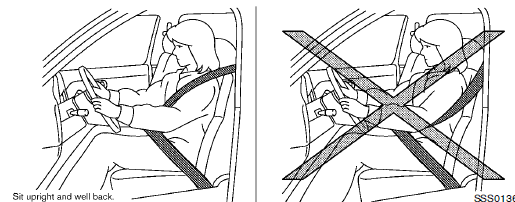
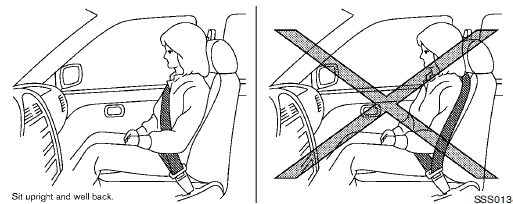
If you are wearing your seat belt properly adjusted, and you are sitting upright and well back in your seat with both feet on the floor, your chances of being injured or killed in an accident and/or the severity of injury may be greatly reduced. NISSAN strongly encourages you and all of your passengers to buckle up every time you drive, even if your seating position includes a supplemental air bag.
Most U.S. states and Canadian provinces or territories specify that seat belts be worn at all times when a vehicle is being driven.
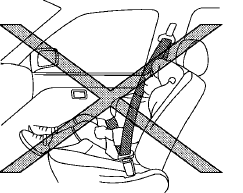
WARNING
• Every
person who drives or rides in
this vehicle should use a seat belt at
all times. Children should be properly
restrained in the rear seat and,
if appropriate, in a child restraint.
• The seat belt
should be properly
adjusted to a snug fit. Failure to do
so may reduce the effectiveness of
the entire restraint system and increase
the chance or severity of
injury in an accident. Serious injury
or death can occur if the seat belt is
not worn properly.
• Always route the
shoulder belt over
your shoulder and across your
chest. Never put the belt behind
your back, under your arm or across
your neck. The belt should be away
from your face and neck, but not
falling off your shoulder.
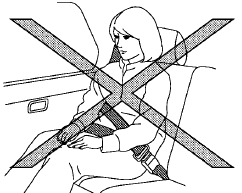
• Position the lap
belt as low and
snug as possible AROUND THE
HIPS, NOT THE WAIST. A lap belt
worn too high could increase the
risk of internal injuries in an accident.
• Be sure the seat
belt tongue is
securely fastened to the proper
buckle.
• Do not wear the
seat belt inside out
or twisted. Doing so may reduce its
effectiveness.
• Do not allow
more than one person
to use the same seat belt.
• Never carry more
people in the
vehicle than there are seat belts.
• If the seat belt
warning light glows
continuously while the ignition is
pushed to the ON position with all
doors closed and all seat belts
fastened, it may indicate a malfunction
in the system. Have the system
checked by a NISSAN dealer.
• No changes
should be made to the
seat belt system. For example, do
not modify the seat belt, add material,
or install devices that may
change the seat belt routing or
tension. Doing so may affect the
operation of the seat belt system.
Modifying or tampering with the
seat belt system may result in
serious personal injury.
• Once a seat belt
pretensioner has
activated, it cannot be reused and
must be replaced together with the
retractor. See a NISSAN dealer.
• Removal and
installation of the
pretensioner system components
should be done by a NISSAN dealer.
• All seat belt
assemblies, including
retractors and attaching hardware,
should be inspected after any collision
by a NISSAN dealer. NISSAN
recommends that all seat belt assemblies
in use during a collision be
replaced unless the collision was
minor and the belts show no damage
and continue to operate properly.
Seat belt assemblies not in use
during a collision should also be
inspected and replaced if either
damage or improper operation is
noted.
• All child
restraints and attaching
hardware should be inspected after
any collision. Always follow the
restraint manufacturer’s inspection
instructions and replacement recommendations.
The child restraints should be replaced if they are damaged.
See also:
Rear Door Alert. Power outlets. USB/iPod charging ports
Rear Door Alert
The Rear Door Alert system is designed to operate under specific conditions and remind the driver that an object,
item, or passenger may be present in the rear seat area. Before lea ...
Windshield wiper and washer switch
WARNING
In freezing temperatures the washer
solution may freeze on the windshield
and obscure your vision which may lead
to an accident. Warm windshield with
the defroster before you wash the
wi ...
Child safety rear door lock (Hardtop models)
The child safety rear door locks help prevent
doors from being opened accidentally, especially
when small children are in the vehicle.
When the levers are in the lock position
1 , the rear doors ...