
Inside mirror
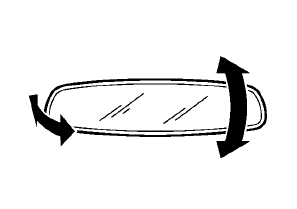
Adjust the height and the angle of the inside mirror to the desired position.
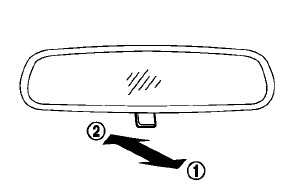
Manual anti-glare type
The night position1 will reduce glare from the headlights of vehicles behind you at night.
Use the day position2 when driving in daylight hours.
WARNING
Use the night position only when necessary, because it reduces rear view clarity.
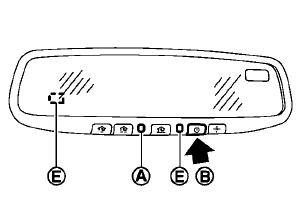
Type A
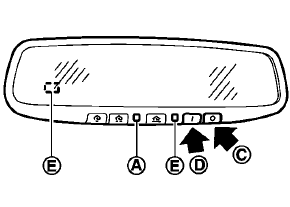
Type B
Automatic anti-glare type
The inside mirror is designed so that it automatically changes reflection according to the intensity of the headlights of the following vehicle.
The anti-glare system will be automatically turned on when the ignition switch is pushed to the ON position.
When the anti-glare system is turned on, the indicator light A will illuminate and excessive glare from the headlights of the vehicle behind you will be reduced.
Type A: Push the  switch B to make
the
inside rearview mirror operate normally and the
indicator light will turn off. Push the switch
again to turn the system on.
switch B to make
the
inside rearview mirror operate normally and the
indicator light will turn off. Push the switch
again to turn the system on.
Type B: Push the “ ” switch C to
make the
inside rearview mirror operate normally. The
indicator light will turn off. Push the “I” switch
D to turn the system on.
” switch C to
make the
inside rearview mirror operate normally. The
indicator light will turn off. Push the “I” switch
D to turn the system on.
Do not allow any object to cover the sensors E or apply glass cleaner on them. Doing so will reduce the sensitivity of the sensor, resulting in improper operation.
For the compass (if so equipped) operation, see “Compass” in the “2. Instruments and controls” section.
For the HomeLink® Universal Transceiver operation, see “HomeLink® Universal Transceiver” in the “2. Instruments and controls” section.
See also:
Basic Information
The Traffic Sign Recognition (TSR) system provides the driver with information about the most recently detected
speed limit. A multi-sensing front camera unit A, mounted on the windshield in fro ...
Luggage hooks
When securing items using luggage hooks located
on the back of the seat or side finisher do
not apply a load over more than 6.5 lbs (29 N) to
a single hook.
The luggage hooks that are located ...
NISSAN voice recognition Standard Mode
The following section is applicable when the
Standard Mode is activated.
The Standard Mode enables you to complete
the desired operation by simply following the
prompts that appear on the displa ...