
Tire labeling
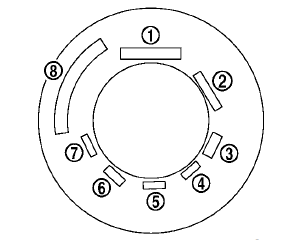
Example
Federal law requires tire manufacturers to place standardized information on the sidewall of all tires. This information identifies and describes the fundamental characteristics of the tire and also provides the tire identification number (TIN) for safety standard certification. The TIN can be used to identify the tire in case of a recall.
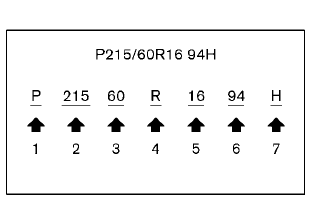
Example
1 Tire size (example: P215/60R16 94H)
1. P: The “P” indicates the tire is designed
for passenger vehicles. (Not all tires
have this information.)
2. Three-digit number (215): This number
gives the width in millimeters of the tire
from sidewall edge to sidewall edge.
3. Two-digit number (60): This number,
known as the aspect ratio, gives the
tire’s ratio of height to width.
4. R: The “R” stands for radial.
5. Two-digit number (16): This number is
the wheel or rim diameter in inches.
6. Two- or three-digit number (94): This
number is the tire’s load index. It is a
measurement of how much weight each
tire can support. You may not find this
information on all tires because it is not
required by law.
7. H: Tire speed rating. You should not
drive the vehicle faster than the tire
speed rating.
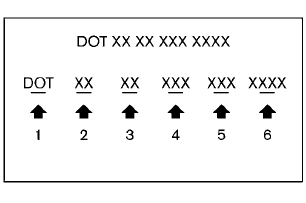
Example
2 TIN (Tire Identification Number) for a new tire (example: DOT XX XX XXX XXXX)
1. DOT: Abbreviation for the “Department
of Transportation”. The symbol can be
placed above, below or to the left or
right of the Tire Identification Number.
2. Two-digit code: Manufacturer’s identification
mark
3. Two-digit code: Tire size
4. Three-digit code: Tire type code (Optional)
5. Three-digit code: Date of Manufacture
6. Four numbers represent the week and
year the tire was built. For example, the
numbers 3103 means the 31st week of
2003. If these numbers are missing,
then look on the other sidewall of the
tire.
3 Tire ply composition and material The number of layers or plies of rubber-coated fabric in the tire.
Tire manufacturers also must indicate
the materials in the tire, which include
steel, nylon, polyester, and others.
4 Maximum permissible inflation pressure
This number is the greatest amount of
air pressure that should be put in the
tire. Do not exceed the maximum
permissible inflation pressure.
5 Maximum load rating
This number indicates the maximum
load in kilograms and pounds that can
be carried by the tire. When replacing
the tires on the vehicle, always use a
tire that has the same load rating as
the factory installed tire.
6 Term of “tubeless” or “tube type”
Indicates whether the tire requires an
inner tube (“tube type”) or not (“tubeless”).
7 The word “radial”
The word “radial” is shown, if the tire
has radial structure.
8 Manufacturer or brand name
Manufacturer or brand name is shown.
Other tire-related terminology:
In addition to the many terms that are defined throughout this section, Intended Outboard Sidewall is (1) the sidewall that contains a whitewall, bears white lettering or bears manufacturer, brand and/or model name molding that is higher or deeper than the same molding on the other sidewall of the tire, or (2) the outward facing sidewall of an asymmetrical tire that has a particular side that must always face outward when mounted on a vehicle.
See also:
Three-way catalyst
The three-way catalyst is an emission control
device installed in the exhaust system. Exhaust
gases in the three-way catalyst are burned at
high temperatures to help reduce pollutants.
WARNING
&# ...
Daytime running light system (Canada only)
The daytime running lights automatically illuminate
when the engine is started with the parking
brake released. The daytime running lights operate
with the headlight switch in the OFF position
or ...
Control buttons
1. PHONE SEND button
Push the button to initiate a VR session or
answer an incoming call. You can also use
the button to skip through system feedback
and to enter commands during a call.
2. PH ...