
Booster seats
Basic Information
For additional information about installing a booster seat in your vehicle, follow the guidance in this section carefully. A booster seat is used to help position the vehicle lap/shoulder belt correctly on a child who has outgrown a forward-facing child restraint but is not yet large enough for the seat belt to fit properly without assistance.
Precautions on booster seats
WARNING If a booster seat and seat belt are not used correctly, the risk of a child being seriously injured or killed in a sudden stop or collision increases greatly:
- Make sure the shoulder portion of the belt stays away from the child's face and neck, and make sure the lap portion of the belt does not cross the stomach.
- Make sure the shoulder belt is never placed behind the child or under the child's arm. Incorrect shoulder belt routing can prevent the belt from restraining the child properly.
- A booster seat must only be installed in a seating position equipped with a lap/shoulder belt. Do not use a booster seat with a belt system that cannot provide proper upper-body and lap restraint.
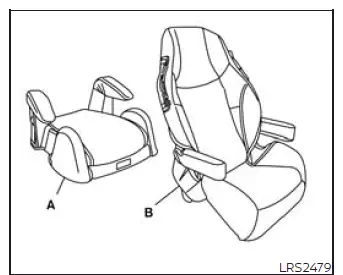
- Low back booster seat, used only when the vehicle seatback or head restraint/headrest provides proper support for the child's head.
- High back booster seat, used when added back and head support is needed for proper child seating position.
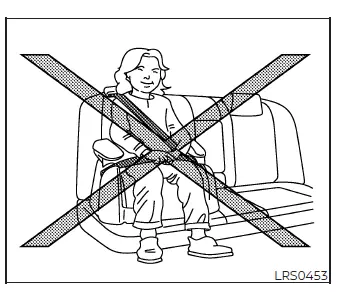
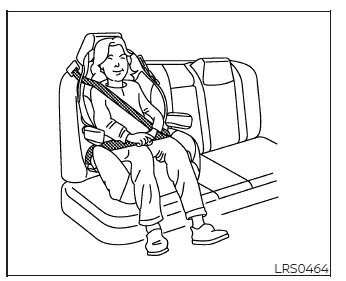
Booster seats of various sizes are offered by several manufacturers. When selecting any booster seat for the Nissan Murano, keep the following points in mind so the seat fits both the child and the selected vehicle seating position:
- Choose only a booster seat with a label certifying that it complies with Federal Motor Vehicle Safety Standard 213 or Canadian Motor Vehicle Safety Standard 213.
- Check the booster seat in your vehicle to confirm that it is compatible with the vehicle seat shape, seatback, head restraint/headrest, and seat belt system.
- Make sure the child's head will be properly supported by the booster seat or by the vehicle seat. The seatback must be at or above the center of the child's ears. For example, if a low back booster seat is chosen, the vehicle seatback must reach at least the center of the child's ears. If the seatback is lower than the center of the child's ears, a high back booster seat should be used.
- If the booster seat is compatible with your vehicle, place the child in the booster seat and check the available adjustments to make sure the booster seat fits the child correctly. The child should be able to sit upright, with the belt routed as intended, and all recommended procedures from the booster seat manufacturer should be followed.
All U.S. states and Canadian provinces or territories require that infants and small children be restrained in an approved child restraint whenever the vehicle is being operated. The instructions in this section apply to booster seat installation in the rear seats or the front passenger seat.
Booster seat installation
WARNING To avoid injury to the child, do not use the lap/shoulder belt in Automatic Locking Retractor (ALR) mode when using a booster seat with the seat belts. A booster seat is intended to position the child so the vehicle belt fits correctly during normal belt operation.
Follow these steps to install a booster seat in the rear bench seats or in the front passenger seat:
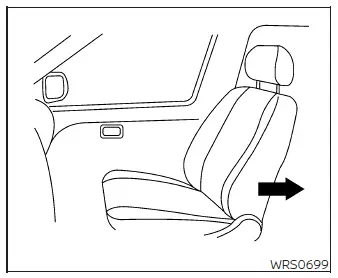
Forward-facing (front passenger seat) -
step 1
1. If you must install a booster seat in the front seat, move the seat to the rearmost position before placing the booster seat on it.
2. Position the booster seat on the seat. Make sure it sits flat and stable on the seat cushion and is not tilted, twisted, or resting in a way that interferes with the seat belt path.
Only place it in a front-facing direction.
Always follow the booster seat manufacturer's instructions for placement, belt routing, child position, and any required adjustments.
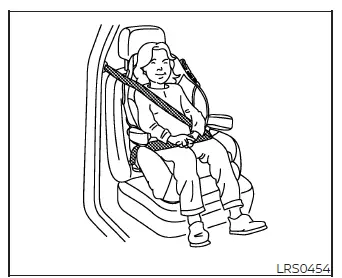
Front passenger position
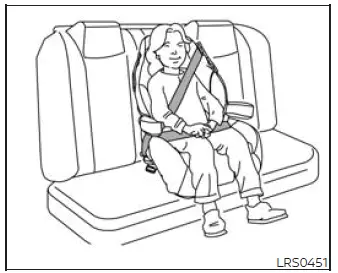
Rear center position
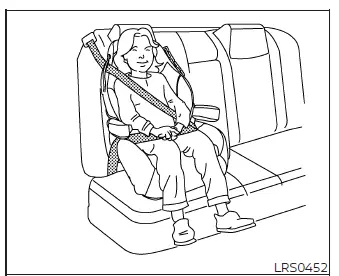
Rear outboard position
3. The booster seat should be positioned on the vehicle seat so that it is stable. It should not rock, slide excessively, or prevent the child from sitting upright with the vehicle belt routed correctly.
If necessary, adjust or remove the head restraint/headrest to obtain the correct booster seat fit. If the head restraint/headrest is removed, store it in a secure place so it cannot move around the cabin during sudden braking or a collision. Be sure to reinstall the head restraint/headrest when the booster seat is removed.
If the seating position does not have an adjustable head restraint/headrest and it interferes with proper booster seat fit, try another seating position in the Nissan Murano or use a different booster seat that fits the seat more correctly.
4. Position the lap portion of the seat belt low and snug on the child's hips. Be sure to follow the booster seat manufacturer's instructions for adjusting the seat belt routing. The lap belt should not ride up across the abdomen.
5. Pull the shoulder belt portion of the seat belt toward the retractor to take up extra slack. Make sure the shoulder belt is positioned across the upper, middle portion of the child's shoulder. It should not touch the face or neck, and it should not fall off the shoulder. Follow the booster seat manufacturer's instructions for the correct shoulder belt routing.
6. Follow the warnings, cautions, and instructions for properly fastening a seat belt shown in "Three-point type seat belt with retractor". The child should remain seated correctly for the entire ride, with the belt lying flat and untwisted.
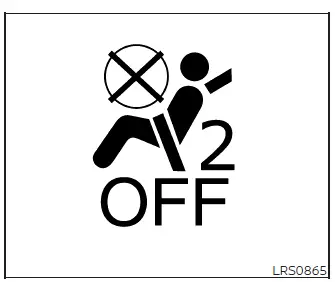
7. If the booster seat is installed in the front passenger seat, place the ignition switch in the ON position.
The front passenger air bag status light
 may or may not illuminate, depending on the size of the
child and the type of booster seat being used.
may or may not illuminate, depending on the size of the
child and the type of booster seat being used.
See also:
Entry/exit function (for Hardtop models)
This system is designed so that the driver’s seat
and steering column will automatically move
when the shift lever is in the P (Park) position.
This allows the driver to get into and out of the ...
Anti-lock Braking System (ABS)
WARNING
● The Anti-lock Braking System (ABS) is a
sophisticated device, but it cannot prevent
accidents resulting from careless
or dangerous driving techniques. It can
help maintain vehicle ...
Automatic operation (if so equipped)
Tilt and telescopic operation
To adjust the steering wheel move the switch 1
in the following directions:
● Adjust the steering wheel forward or backward
in direction 3 to the desired telesc ...