
Automatic Transmission (A/T)
Basic Information
WARNING
- Do not press the accelerator pedal while shifting from P (Park) or N (Neutral) into R (Reverse), D
(Drive), or M (Manual shift mode). Keep the foot brake pedal firmly depressed until the shift has been
completed and the selected position is fully engaged.
Failure to follow this procedure could cause the Nissan Murano to move unexpectedly, resulting in a loss of vehicle control, a collision, and serious injury.
- Engine idle speed is higher when the engine is cold. Use additional caution when selecting a forward or reverse position before the engine has warmed up, because the vehicle may begin moving more quickly than expected when the brake pedal is released.
- Do not make an abrupt downshift while driving on a slippery road. A sudden change in transmission ratio may reduce tire traction and cause the driver to lose control of the vehicle.
- Never select P (Park) or R (Reverse) while the vehicle is moving forward. Likewise, never select P (Park) or D (Drive) while the vehicle is moving backward. Selecting a transmission position opposite to the direction of travel could cause a collision or serious transmission damage.
CAUTION
- To prevent possible damage to the vehicle, do not hold the Nissan Murano stationary on an uphill grade by pressing the accelerator pedal. Use the foot brake to keep the vehicle stopped until you are ready to continue driving.
- Except in an emergency, do not shift the transmission into N (Neutral) while the vehicle is moving.
Coasting with the transmission in N (Neutral) removes normal driving engagement and may cause serious damage to the transmission.
The Automatic Transmission in this vehicle is electronically controlled to provide smooth operation while delivering the power required for changing road and driving conditions. The system automatically selects appropriate transmission ratios during normal driving.
The recommended procedures for operating the transmission are described in the following sections. Following these instructions will help maintain smooth shifting, dependable transmission operation, and the intended driving performance of the Nissan Murano.
Engine output may be reduced automatically to protect the Automatic Transmission if engine speed rises rapidly while the vehicle is being driven on a slippery surface or tested on certain types of dynamometers. This temporary reduction is part of the transmission protection strategy and may affect acceleration.
Starting the vehicle
1. After starting the engine, fully depress and hold the foot brake pedal before attempting to move the shift position out of P (Park).
The Automatic Transmission is designed with a shift interlock that requires the foot brake pedal to be depressed before the transmission can be shifted from P (Park) into any driving position while the ignition switch is in the ON position.
The shift position cannot be moved out of P (Park) and into another position when the engine is not running. Start the engine and keep the brake pedal depressed before selecting the required driving position.
2. Continue holding the foot brake pedal firmly while moving the shift position into R (Reverse), D (Drive), or M (Manual shift mode), depending on the intended direction and driving conditions.
3. Release the parking brake, then gradually release the foot brake pedal and gently apply the accelerator as needed to begin moving. Confirm that the surrounding area is clear before allowing the vehicle to proceed.
WARNING
- Do not press the accelerator pedal while shifting from P (Park) or N (Neutral) into R (Reverse), D
(Drive), or M (Manual) range. Keep the brake pedal depressed until the transmission has completed the
shift.
Pressing the accelerator during this process could cause sudden vehicle movement, loss of control, and an accident.
- Because cold engine idle speed is higher than normal, exercise particular care when selecting a forward or reverse position before the engine has warmed up. Maintain firm brake pressure to prevent unintended movement.
- Never downshift abruptly on wet, icy, snowy, or otherwise slippery roads. A sudden downshift can disturb tire grip and may cause the vehicle to skid or become difficult to control.
- Do not select P (Park) or R (Reverse) while the vehicle is traveling forward, and do not select P (Park) or D (Drive) while the vehicle is traveling backward. An improper shift while the Nissan Murano is moving could result in an accident or damage the Automatic Transmission.
CAUTION
- To avoid possible vehicle or transmission damage when stopped on an uphill grade, do not use accelerator pressure to prevent the vehicle from rolling backward. Hold the vehicle with the foot brake instead.
- Do not shift into N (Neutral) while driving unless an emergency makes it necessary. Coasting in N (Neutral) may prevent normal power delivery and can cause serious damage to the transmission.
- Do not coast with the transmission in N (Neutral). Driving with the transmission disengaged may reduce normal control of vehicle movement and can cause serious damage to the transmission.
- WARM UP THE ENGINE — Engine idle speed is higher while the engine is cold.
Use extra caution when selecting a driving position immediately after starting the engine. Keep the brake pedal firmly depressed and be prepared for the Nissan Murano to begin moving more readily than it would after the engine has warmed up.
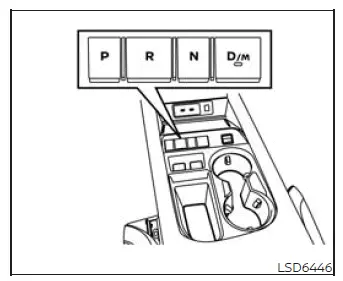
Shifting
Basic information
After starting the engine, fully depress and hold the brake pedal, then operate the appropriate shift button to select R (Reverse), N (Neutral), or D (Drive)/M (Manual shift mode). Maintain firm brake pressure until the requested transmission position has been engaged.
After pressing a shift button, check the displayed shift position and confirm that the transmission has changed to the intended setting before releasing the brake pedal or applying the accelerator. Do not rely only on the movement of your hand or the button response when verifying the selected position.
NOTE:
- P (Park) is engaged automatically under either of the following conditions:
- The ignition switch is placed in the OFF position.
- The driver's seat belt is unfastened and the driver's door is opened while the vehicle is stationary or moving at a very low speed, the driver's foot is off the brake pedal, and the transmission is in D (Drive), N (Neutral), R (Reverse), or M (Manual) mode.
- The Nissan Murano normally shifts automatically into P (Park) when the ignition switch is placed in the
OFF position.
However, if the electric shift control system malfunctions and the ignition switch is operated while the transmission is in a position other than P (Park), a buzzer will sound and the ignition switch may not move to OFF. If this condition occurs, complete the following procedure in order:
- Bring the vehicle to a complete stop and apply the parking brake securely.
- Keep the brake pedal firmly depressed and push the ignition switch to place it in the ON position.
- Press the P (Park) button and confirm that the transmission changes to P (Park).
- Push the ignition switch again to place it in the OFF position.
WARNING
- If you use an implantable cardiac pacemaker, an implantable cardioverter defibrillator (ICD), or another
implanted medical device, keep the part of your body containing the device away from the shift buttons.
The strong magnet located in the shift-button assembly may interfere with the operation of certain medical devices. Follow the instructions provided by the medical-device manufacturer regarding exposure to magnetic fields.
- Keep magnetic cards and other magnetically sensitive or magnetic objects away from the shift buttons. Their presence may interfere with shift-button operation, cause a malfunction, or contribute to unintended transmission selection and an accident.
- Apply the parking brake whenever the engine is not running and the transmission is in any position. Failure to secure the Nissan Murano could allow it to move unexpectedly or roll away, resulting in serious personal injury or property damage.
- When driving or maneuvering on a hill, do not allow the vehicle to roll backward while D (Drive) or M (Manual) mode is selected. Likewise, do not allow the vehicle to roll forward while R (Reverse) is selected. Movement opposite to the selected transmission direction may result in loss of control or a collision.
CAUTION Before selecting P (Park), make sure the vehicle has come to a complete stop. Confirm that the transmission is securely in P (Park) before leaving the driver's seat.
P (Park)
Use P (Park) when parking the vehicle and when starting the engine. Always bring the Nissan Murano to a complete stop before selecting this position, because engaging P (Park) while the vehicle is still moving may damage the transmission.
The brake pedal must be depressed before changing from N (Neutral) or any driving position to P (Park). Apply the parking brake whenever the vehicle is parked. When parking on a hill, first hold the vehicle stationary with the foot brake, apply the electronic parking brake, and then select P (Park). This sequence helps secure the vehicle before brake-pedal pressure is released.
The parking lock must not be used as a substitute for the braking system when the vehicle is parked. To secure the Nissan Murano properly, always apply the electronic parking brake in addition to selecting P (Park). Using both systems helps prevent unintended movement, particularly when the vehicle is parked on an incline.
If a malfunction occurs in the vehicle's electronic control system, the transmission may become locked in the P (Park) position and normal shifting may no longer be possible. Have the vehicle's electronics inspected as soon as possible to prevent the condition from affecting further operation.
NISSAN recommends visiting a NISSAN dealer for diagnosis and service.
The P (Park) position is automatically engaged if:
- The ignition switch is placed in the OFF position.
- The driver's seat belt is unfastened and the driver's door is opened while the vehicle is stationary or moving at a very low speed, the driver's foot is not pressing the brake pedal, and the transmission is in D (Drive), N (Neutral), R (Reverse), or M (Manual) mode.
CAUTION Select P (Park) only after the Nissan Murano has come to a complete stop. Engaging this position while the vehicle is still moving may damage the transmission.
NOTE:
- If the vehicle is stationary and the transmission is in any position other than P (Park) when the ignition switch is moved to OFF, the transmission will automatically change to P (Park).
- If the P (Park) button is pressed while the vehicle is moving, the requested shift will be canceled. A buzzer will sound, and the transmission will remain in the position selected before the button was pressed.
R (Reverse)
Use R (Reverse) only when backing up. Always make sure the vehicle has stopped completely before selecting this position. The brake pedal must be firmly depressed when changing from P (Park), N (Neutral), or any forward driving position into R (Reverse). Confirm that the area behind the vehicle is clear before releasing the brake pedal.
NOTE: If R (Reverse) is selected while the vehicle is still moving forward, a chime will sound and the transmission will automatically change to N (Neutral) instead of engaging reverse.
N (Neutral)
In N (Neutral), neither a forward nor a reverse driving gear is engaged, so engine power is not transmitted to move the vehicle in either direction.
The engine can be started while the transmission is in this position. If the engine stalls while the Nissan Murano is moving, N (Neutral) may be selected so the engine can be restarted while the vehicle remains in motion.
D (Drive)
Use D (Drive) for normal forward driving. In this position, the transmission operates automatically to provide suitable performance for ordinary road and traffic conditions.
NOTE: If D (Drive) is selected while the vehicle is moving backward, a chime will sound and the transmission will automatically change to N (Neutral) rather than engaging a forward driving position.
Neutral hold mode function
The neutral hold mode function allows the driver to leave the vehicle while the transmission remains in N (Neutral) and the engine continues running. When this function is active, the vehicle can be moved by hand, such as when it must roll through certain types of car-washing equipment.
Before using neutral hold mode, release the electronic parking brake so the Nissan Murano can move freely when pushed. Use the function only under the controlled conditions described below.
WARNING
- Activate neutral hold mode only on a level surface. If the vehicle is positioned on a slope, it may begin moving unexpectedly and cause a collision, serious personal injury, or property damage.
- Do not use this function for any purpose other than car washing. It is not intended for parking, towing, maintenance, or leaving the vehicle unsecured.
- Do not turn off the engine after neutral hold mode has been activated. If the engine is switched off, N (Neutral) will not be maintained and the transmission will automatically change to P (Park).
- If neutral hold mode does not activate even though the correct procedure has been followed, the transmission or its electronic control system may be malfunctioning. NISSAN recommends having the vehicle inspected by a NISSAN dealer.
To activate Neutral hold mode, complete the following steps in the order shown:
1. Push the ignition switch to start the engine.
2. Release the electronic parking brake so the Nissan Murano can move freely when Neutral hold mode is active.
3. Depress and continue holding the brake pedal firmly.
4. Press the P (Park) button.
5. Press the N (Neutral) button twice until "N" appears in the vehicle information display, confirming that the transmission has changed to Neutral.
6. Press the N (Neutral) button twice again until the message "Neutral Hold Mode has been activated" appears in the vehicle information display.
7. Keep the ignition switch in the ON position while Neutral hold mode is being used. If the ignition is switched off, the function will be canceled and the transmission will automatically engage P (Park).
To exit Neutral hold mode, select any transmission position other than N (Neutral). Confirm the newly selected position in the vehicle information display before attempting to move the Nissan Murano.
NOTE:
- Steps 4 through 6 must be completed within approximately 5 seconds. Performing the sequence promptly helps ensure that the function is activated correctly.
- When the transmission changes to N (Neutral), a corresponding message will appear in the vehicle information display to confirm the selected position.
- If Neutral hold mode is temporarily unavailable, a message will appear in the vehicle information
display.
Wait briefly without operating the shift controls, and then repeat the activation procedure from the beginning.
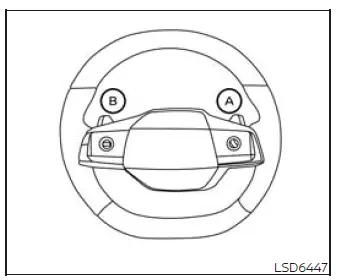
Manual shift mode
Basic information
While driving with the transmission already in D (Drive), selecting D (Drive) again activates manual shift mode. This allows the driver to choose the preferred shift range while continuing to operate the Nissan Murano in a forward driving position.
The available shift range can be selected manually by using the paddle shifters mounted behind the steering wheel.
To shift up, pull the right-side paddle shifter (+) A. The transmission will move to the next higher available range.
To shift down, pull the left-side paddle shifter (−) B. The transmission will move to the next lower available range.
To cancel manual shift mode, select D (Drive) again. The transmission will return to its normal automatic driving mode and resume selecting shift ranges electronically.
If either paddle shifter is pulled while the transmission is operating in D (Drive), the transmission will temporarily change to a higher or lower range according to the paddle selected.
After a short period, the transmission will automatically return to normal D (Drive) operation. To return to D (Drive) manually before this occurs, pull and hold either paddle shifter for approximately 1.5 seconds.
Paddle-shifter operation is available only when the vehicle is being driven in D (Drive) at a speed above approximately 8 mph (12 km/h).
While manual shift mode is active, the currently selected shift range is shown in the vehicle information display, allowing the driver to confirm each requested change.
The shift ranges move up or down one step at a time in the following sequence:
1M⇔2M⇔3M⇔4M⇔5M⇔6M⇔7M⇔8M⇔9M
9M (9th) and 8M (8th)
Use these higher ranges for normal forward driving at highway speeds, where reduced engine speed is suitable for steady cruising conditions.
7M (7th), 6M (6th) and 5M (5th)
Use these ranges when driving up long slopes or when additional engine braking is desired while descending extended grades.
4M (4th), 3M (3rd) and 2M (2nd)
Use these lower ranges when climbing hills or when stronger engine braking is needed while driving downhill.
1M (1st)
Use 1M (1st) when climbing a steep hill at low speed, moving slowly through deep snow, or when maximum engine braking is required on a steep downhill grade. This lowest range provides stronger control at reduced vehicle speeds under demanding driving conditions.
- Avoid driving at high speeds for extended periods while using any range below 8M. Prolonged operation in a lower range increases engine speed and can reduce fuel economy.
- Pulling the same paddle shifter twice can move the transmission through two ranges in succession. However, if the paddle is operated too rapidly, the second requested shift may not be completed.
- While manual shift mode is active, the transmission may refuse to engage the range selected by the driver when that shift would be unsuitable for the current vehicle speed or operating conditions. This protective control helps preserve driving performance while reducing the possibility of transmission damage or loss of vehicle control.
- In manual shift mode, the transmission may automatically shift to a higher range than the one selected if engine speed becomes excessive. As the Nissan Murano slows down, the transmission will downshift automatically and select 1st range before the vehicle comes to a complete stop.
Accelerator downshift - in D (Drive) position -
When additional acceleration is needed for passing another vehicle or climbing a hill, depress the accelerator pedal fully. Depending on the current vehicle speed, the transmission will automatically shift into a lower gear to provide stronger acceleration and increased engine response.
High fluid temperature protection mode
The transmission is equipped with a high fluid temperature protection mode. This mode may activate if the transmission fluid becomes excessively hot, such as when the Nissan Murano is climbing steep grades in high ambient temperatures while carrying a heavy load or towing a trailer. To reduce the risk of transmission damage, the system may automatically limit engine output and, under certain conditions, reduce vehicle speed. The accelerator pedal will continue to control the vehicle, but available engine speed, acceleration, and road speed may be restricted until the transmission temperature decreases.
Fail-safe
When fail-safe operation is activated, the transmission may become locked in one of the forward gears, depending on the condition detected. Acceleration and shifting performance may be limited while the system remains in this protective mode.
If the vehicle is operated under extreme conditions, including excessive wheel spinning followed by sudden or heavy braking, the fail-safe system may activate to protect the transmission and related components.
The Malfunction Indicator Light (MIL) may illuminate when fail-safe mode is activated. This can occur even when the transmission's electrical circuits are functioning correctly, because the light may be triggered by the unusual operating condition rather than by a permanent electrical failure.
If this occurs, stop the Nissan Murano in a safe location, place the ignition switch in the OFF position, and wait approximately 10 seconds.
After waiting, return the ignition switch to the ON position. The transmission should resume normal operation. If normal performance does not return, or if the Malfunction Indicator Light remains illuminated even after the vehicle appears to operate normally, NISSAN recommends having the vehicle inspected by a NISSAN dealer.
WARNING When high fluid temperature protection mode or fail-safe operation is active, vehicle speed may decrease gradually and could become lower than the speed of surrounding traffic. This difference in speed can increase the risk of a collision. Drive with particular caution, monitor traffic conditions closely, and avoid sudden maneuvers. If the Nissan Murano cannot maintain a safe speed, move carefully to the side of the road and stop in a secure location. Allow the transmission to cool and return to normal operation, or arrange for inspection and repair if the condition continues.
See also:
Break-in schedule
CAUTION
During the first 1,200 miles (2,000 km),
follow these recommendations to obtain
maximum engine performance and
ensure the future reliability and economy
of your new vehicle. Failure to
f ...
Warning and indicator lights
All-Wheel Drive (AWD) warning light (AWD models)*
Anti-lock Braking System (ABS) warning light
Brake warning light
Charge warning light
Electric power steering warning light
Engine oi ...
Installing front license plate
Use the following steps to mount the front license
plate:
Before mounting the license plate, confirm that
the following parts are enclosed in the plastic
bag:
● License plate bracket
...