
RCTA system limitations
WARNING The limitations of the RCTA system are described below. Failure to operate the Nissan Murano in accordance with these limitations, or relying on the system instead of checking the surrounding area, could result in a collision, serious injury, or death.
- Always inspect the surroundings and turn to look behind the vehicle before backing up. The radar sensors
are designed primarily to detect approaching moving vehicles and cannot identify every road user or
object, including:
- Pedestrians, bicycles, motorcycles, animals, or toy vehicles operated by children.
- A vehicle passing behind your vehicle at a speed greater than approximately 19 mph (30 km/h).
- A vehicle passing behind your vehicle at a speed lower than approximately 5 mph (8 km/h).
- The radar sensors may be unable to detect approaching vehicles in certain parking arrangements or traffic
situations, including the following:
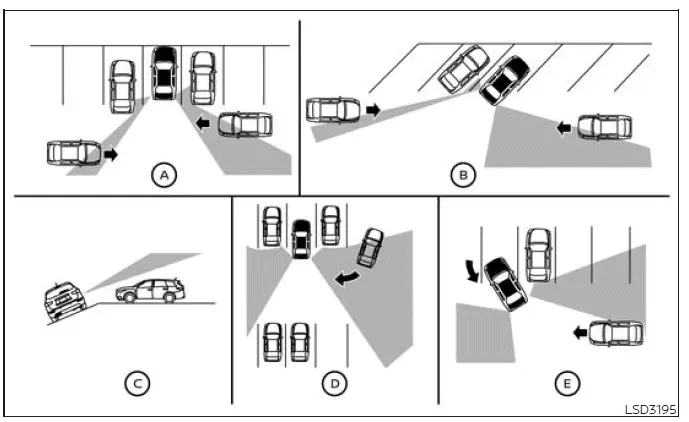
- Illustration A: When a vehicle parked beside your vehicle blocks or limits the radar sensor beam.
- Illustration B: When your vehicle is positioned in an angled parking space, changing the direction in which the radar sensors monitor cross traffic.
- Illustration C: When the vehicle is parked on inclined ground and the radar detection area does not align normally with approaching traffic.
- Illustration D: When an approaching vehicle turns into the parking aisle rather than traveling directly across the monitored area.
- Illustration E: When the angle between your vehicle and the approaching vehicle is small, making the cross-traffic movement more difficult for the radar sensors to identify.
- When your vehicle and the approaching vehicle are positioned at a small angle to each other, the other vehicle may remain outside the effective radar detection path or may be detected late.
- The following environmental conditions may reduce the radar sensors' ability to detect approaching
vehicles accurately:
- Severe weather that interferes with radar operation or reduces visibility.
- Heavy road spray caused by wet pavement or surrounding vehicles.
- Ice, frost, snow, mud, or dirt accumulating on the vehicle near the rear radar sensor areas.
- Do not attach stickers, including transparent films or materials, install accessories, or apply additional paint near the radar sensors. Any obstruction or modification in these areas may interfere with radar signals and reduce the system's ability to detect approaching vehicles.
- Excessive noise, such as a high audio system volume or an open vehicle window, may make the warning chime difficult or impossible to hear. Continue checking the mirrors and surrounding area visually rather than relying only on the audible alert.
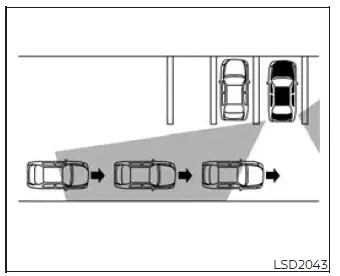
Illustration 1
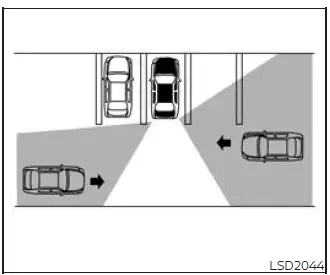
Illustration 2
NOTE: When several vehicles approach in succession, as shown in Illustration 1, or approach from opposite directions, as shown in Illustration 2, the RCTA system may not sound another warning chime after the first vehicle has passed the radar sensors. Always continue observing both sides while reversing, even after an initial warning has ended.
See also:
Engine coolant temperature gauge
The gauge indicates the engine coolant temperature.
The engine coolant temperature is within the
normal range 1 when the gauge needle points
within the zone shown in the illustration.
The en ...
System temporarily unavailable
Under any of the conditions described below, a warning chime will sound, a corresponding message will appear in
the vehicle information display, and the I-BSI system will switch off automatically b ...
BSW system operation
Blind Spot Indicator light
BSW light (orange, green)
The BSW system operates above approximately
20 MPH (32 km/h).
When the camera unit detects vehicles in the
detection zone, the Blind Spo ...