
System temporarily unavailable
Basic Information
When the system detects that one or both radar sensors are blocked or cannot monitor the surrounding area reliably, the affected driver-assistance functions will be deactivated automatically.
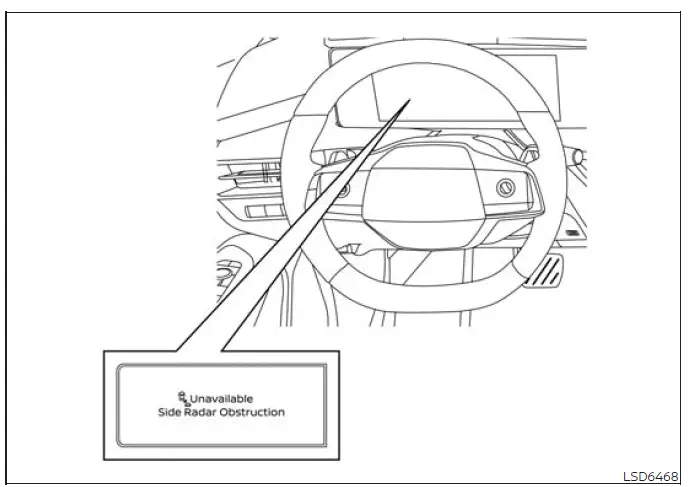
The "Unavailable: Side Radar Obstruction" warning message will appear in the vehicle information display, informing the driver that the side radar sensors are temporarily unable to provide normal detection.
The affected systems will remain unavailable until the condition interfering with radar operation is no longer present. During this period, the driver must check the surrounding traffic directly and should not rely on the unavailable warning functions.
The radar sensors may be temporarily blocked by environmental conditions such as splashing water, heavy road spray, mist, or fog. These conditions can interfere with radar detection even when the sensors are clean and undamaged.
The blocked condition may also be caused by ice, snow, frost, mud, dirt, or other material covering or obstructing the radar sensor areas near the rear bumper of the Nissan Murano.
NOTE: If the BSW system stops operating, the RCTA and I-BSI systems will also stop working because these functions use the same side radar sensor information.
Action to take
When the environmental condition or physical obstruction is no longer present, the system will resume operation automatically. Check the radar sensor areas and carefully remove any visible ice, snow, frost, dirt, or other material that may be blocking them.
Malfunction
If the RCTA system malfunctions, it will switch off automatically. The orange BSW indicator will appear in the vehicle information display to notify the driver that the system is not operating normally.
NOTE: If the BSW system stops working because of a malfunction, the RCTA system will also become unavailable.
Action to take
Stop the Nissan Murano in a safe location away from moving traffic, place the shift position in P (Park), turn off the engine, and then restart it. After restarting the engine, check whether the warning message and indicator have disappeared. If the message continues to appear, have the system inspected. It is recommended that you visit a NISSAN dealer for this service.
System maintenance
Basic Information
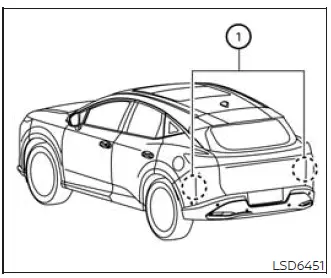
The two radar sensors 1 used by the BSW and RCTA systems are located near the rear bumper. Always keep the areas surrounding both radar sensors clean and free from anything that could interfere with radar transmission or detection.
The radar sensors may be temporarily affected by environmental conditions such as splashing water, road spray, mist, or fog. A temporary warning caused by these conditions does not necessarily indicate that the sensors are damaged.
A blocked-sensor condition may also occur when ice, frost, snow, mud, dirt, or another object accumulates over or around either radar sensor location.
Inspect the areas around both radar sensors whenever an obstruction warning appears. Carefully remove any visible object or material that may be covering the sensors, taking care not to scratch, deform, or damage the surrounding bumper surface.
Do not attach stickers, including transparent films or protective materials, install accessories, or apply additional paint near the radar sensors. Even thin or transparent material may interfere with radar signals and reduce the ability of the Nissan Murano BSW and RCTA systems to detect approaching vehicles.
Do not strike, press against, modify, or damage the areas around the radar sensors. If the rear bumper or the surrounding sensor area is damaged in a collision, sensor alignment or performance may be affected even when the visible damage appears minor. It is recommended that you visit a NISSAN dealer to have the system inspected.
Radio frequency statement
For USA
This device complies with Part 15 of the FCC Rules.
Operation is subject to the following two conditions:
1. This device may not cause harmful interference, and 2. This device must accept any interference received, including interference that may cause undesired operation.
FCC Warning
Changes or modifications that are not expressly approved by the party responsible for compliance could void the user's authority to operate the equipment.
For Canada
This device contains licence-exempt transmitter(s)/receiver(s) that comply with the licence-exempt RSS standard(s) of Innovation, Science and Economic Development Canada.
Operation is subject to the following two conditions:
1. This device may not cause interference.
2. This device must accept any interference, including interference that may cause undesired operation of the device.
Radiofrequency radiation exposure information: This equipment complies with the applicable radiation exposure limits established for an uncontrolled environment. The equipment should be installed and operated with a minimum distance of 20 cm between the radiator and the body of any person, including the user or a bystander.
See also:
Vehicle security system (if so equipped)
The vehicle security system provides visual and
audio alarm signals if someone opens the doors
or lift gate/trunk when the system is armed. It is
not, however, a motion detection type system
that ...
Antenna
Window antenna (for Hardtop models)
The antenna pattern is printed inside the rear
window.
CAUTION
• Do not place metalized film near the
rear window glass or attach any
metal parts to it. Thi ...
California proposition 65 warning
Engine exhaust, some of its constituents, and certain vehicle components contain
or emit chemicals known to the State of California to cause cancer and birth defects
or other reproductive harm. ...