
RAB system limitations
WARNING The following limitations apply to the Rear Automatic Braking (RAB) system. Failure to understand and follow these warnings and operating instructions could result in a collision, serious injury, or death.
- If the Nissan Murano approaches an obstacle while the accelerator or brake pedal is being pressed, the RAB system may not operate, or its response may be delayed. Vehicle condition, driver input, surrounding traffic, weather, road surface, and other operating factors may reduce or prevent automatic braking. Never wait for the system to respond. Press the brake pedal immediately whenever braking is required.
- If it becomes necessary to override RAB operation, press the accelerator pedal firmly. The driver must confirm that accelerating is safe before overriding the automatic braking response.
- Always inspect the area around and behind the vehicle before reversing and continue looking in the
direction of travel throughout the maneuver. The RAB system is designed to detect certain stationary
objects behind the vehicle, but it does not detect every type of obstacle. Objects that may not be
detected include:
- Moving objects, including people, animals, or vehicles crossing behind the Nissan Murano.
- Low objects that are below the effective detection area of the sensors.
- Narrow objects that may not reflect a sufficient sonar signal.
- Wedge-shaped or sharply angled objects.
- Objects positioned very close to the rear bumper, at a distance of less than approximately 1 ft (30 cm).
- Objects that enter the detection area suddenly and leave insufficient time for the system to respond.
- Thin objects such as rope, wire, chain, or similar materials.
- The RAB system may also be unable to respond correctly to the following obstacles:
- Objects positioned high above the ground and outside the primary sensor detection area.
- Objects located to one side or offset from the direct reversing path of the vehicle.
- Objects made from soft or sound-absorbing materials, including sponge-like materials or snow, which may not reflect ultrasonic waves effectively.
- RAB performance may be reduced or unavailable under the following conditions:
- Rain, snow, ice, mud, dirt, or other material is attached to or covering the sonar sensors.
- Loud noise or strong ultrasonic interference is present in the area around the vehicle.
- The surface of the obstacle is positioned at a diagonal angle relative to the rear of the Nissan Murano, reducing the reflected sonar signal.
- The RAB system may activate unexpectedly even when automatic braking is not required under the following
conditions:
- Tall or overgrown grass is present around the vehicle and is detected as an obstacle.
- A wall, toll gate structure, narrow tunnel, parking gate, or similar object is positioned close to the side of the vehicle.
- Bumps, raised surfaces, protrusions, or manhole covers are present on the roadway behind the vehicle.
- The vehicle reverses through or near a hanging flag, curtain, or similar flexible object.
- The Nissan Murano approaches a high curb, wheel stop, or parking barrier.
- Snow or ice has accumulated behind the vehicle or near the rear bumper sensors.
- An ultrasonic source, such as the parking sonar of another vehicle, is operating nearby and interferes with sensor performance.
- After automatic brake control has operated for an obstacle, the RAB system may not apply the brakes again if the vehicle continues approaching or subsequently approaches the same obstacle. The driver must take over braking immediately.
- Automatic brake control is applied only for a limited period.
The driver must press and hold the brake pedal after automatic braking to maintain braking pressure and keep the vehicle stopped.
- The RAB system may not operate correctly or may provide reduced braking assistance in the following
situations:
- The vehicle is being driven in rain, fog, snow, or other adverse weather.
- The vehicle is reversing on a steep uphill or downhill grade.
- The vehicle's angle or body position changes, such as while traveling over a bump or uneven surface.
- The vehicle is being operated on a wet, icy, snowy, or otherwise slippery road.
- The steering wheel is turned fully and the vehicle is reversing through a sharp turn.
- Snow chains are installed on the tires.
- Wheels or tires that are not recommended by NISSAN are installed, which may affect vehicle height, braking, or sensor performance.
- The brakes are cold because of low outside temperatures or because the vehicle has only recently begun moving.
- Braking effectiveness is reduced by wet brakes after driving through standing water or immediately after the vehicle has been washed.
- Switch off the RAB system under the following conditions to reduce the possibility of unexpected braking
or sudden system operation:
- When the vehicle is being towed.
- When the vehicle is being transported on a flatbed truck.
- When the vehicle is positioned on a chassis dynamometer.
- When driving over a severely uneven road surface where sensor readings may be unreliable.
- When the Nissan Murano is towing an object, if the vehicle is equipped for towing.
- When suspension components other than designated Genuine NISSAN parts are installed. Changes to vehicle height or body angle may prevent the sensors from identifying obstacles correctly.
- When an accessory such as a bicycle rack or cargo carrier blocks, covers, or interferes with the rear sensors.
- Excessive interior or exterior noise, including high audio system volume or an open window, may make the RAB warning chime difficult or impossible to hear. The driver must continue monitoring the displays and surrounding area rather than relying only on audible warnings.
System temporarily unavailable
Condition A
When the Vehicle Dynamic Control (VDC) system is switched off, the Rear Automatic Braking (RAB) system becomes temporarily unavailable and the RAB system warning light illuminates in the vehicle information display.
Action to take
Switch the VDC system back on. Once VDC operation has been restored and the required operating conditions are satisfied, the RAB system in the Nissan Murano resumes automatically without requiring a separate reset.
System malfunction
If the RAB system detects a malfunction, it switches off automatically. A warning chime sounds, the message "Malfunction See Owner's Manual" appears in the vehicle information display, and the RAB system warning light illuminates to inform the driver that automatic rear braking assistance is unavailable.
Action to take:
If the warning light illuminates, move the Nissan Murano to a safe location and park the vehicle. Turn the engine off, wait briefly, and restart it. If the warning light remains illuminated after the engine has been restarted, the RAB system may require inspection and should not be relied upon while reversing. It is recommended that you visit a NISSAN dealer for this service.
NOTE: If the RAB system is temporarily unable to operate, the RAB system warning light flashes rather than remaining continuously illuminated. Continue reversing with direct observation and full manual control until the feature becomes available again.
System maintenance
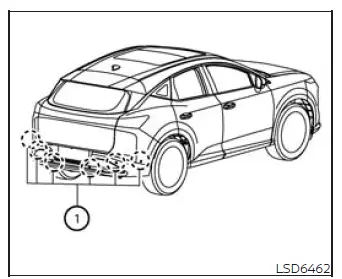
Follow the maintenance guidelines below to help preserve accurate sensor detection and proper operation of the RAB system:
- Keep parking sensors 1 clean and free from dirt, mud, snow, ice, road salt, wax, and other material that could interfere with ultrasonic detection.
- If the parking sensors become dirty, gently wipe their surfaces with a clean, soft cloth. Use care to avoid scratching, pressing, or otherwise damaging the sensors while cleaning them.
- Do not expose the parking sensors 1 or the surrounding bumper area to strong impact. Do not remove, modify, or disassemble the sensors. If an accident or other impact deforms a sensor or the surrounding area, detection performance may be affected even when no obvious damage is visible. Have the sensors inspected; it is recommended that you visit a NISSAN dealer for this service.
- Do not attach stickers, including transparent stickers, protective films, accessories, or decorative items to parking sensors 1 or the areas immediately around them. Covering or altering these areas may cause inaccurate detection, unintended operation, or a RAB system malfunction.
See also:
Brake force distribution
During braking while driving through turns, the
system optimizes the distribution of force to each
of the four wheels depending on the radius of the
turn.
WARNING
● The VDC system is design ...
Changing the meter screen view
Tachometer
Engine coolant temperature gauge
Speedometer
Fuel gauge
For models with the full-screen display, the
meter screen view can be changed to expand
the vehicle ...
During a call
There are some options available during a call.
Select one of the following displayed on the
screen, if necessary:
Hang up:
Finish the call.
Use Handset:
Transfer the call to the cellular ph ...