
Basic Information. AEB with Pedestrian Detection system operation
Basic Information
WARNING Failure to follow the warnings and operating instructions for the Automatic Emergency Braking (AEB) with Pedestrian Detection system could result in a collision, serious injury, or death.
- The AEB with Pedestrian Detection system is a supplemental driver-assistance feature. It does not replace
the driver's responsibility to monitor traffic, maintain a safe following distance, and operate the
Nissan Murano safely.
The system cannot prevent every accident, particularly those caused by inattention, unsafe driving, excessive speed, or delayed driver response.
- The AEB with Pedestrian Detection system cannot function effectively under all driving, traffic, weather, visibility, and road conditions. The driver must remain prepared to steer or brake whenever necessary.
The AEB with Pedestrian Detection system can assist the driver when it identifies a risk of a forward collision with a vehicle traveling ahead in the same lane or with a pedestrian located in the vehicle's forward path. Its warnings and braking assistance are intended to supplement attentive driving rather than replace direct driver action.
Junction Assist can provide additional support in the following situations:
- When the system identifies a risk of a forward collision.
- When the Nissan Murano is turning right or left and crossing the path of an oncoming vehicle.
- When the vehicle is turning right or left and a pedestrian detected ahead is expected to enter the vehicle's projected path.
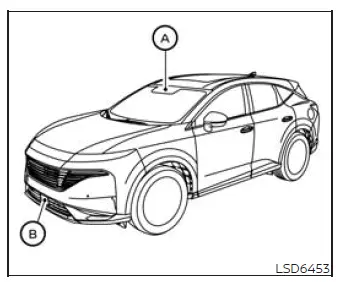
The AEB with Pedestrian Detection system uses radar sensor B, located at the front of the vehicle, to measure the distance to a vehicle traveling ahead in the same lane. To identify pedestrians, the system combines information from the front radar sensor with camera A, which is installed behind the windshield.
AEB with Pedestrian Detection system operation
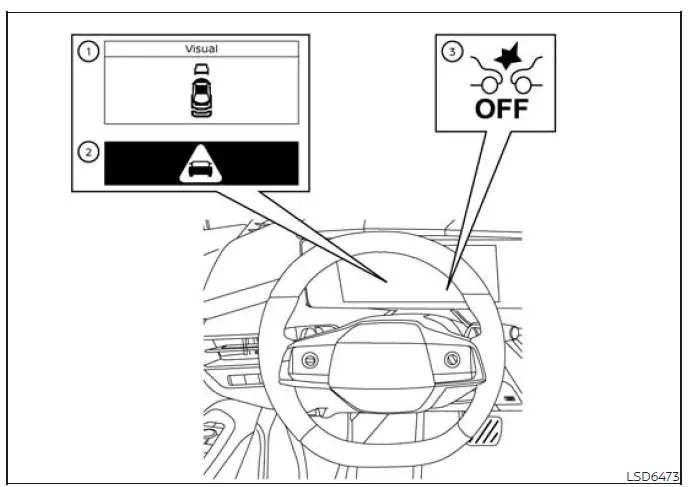
- Vehicle ahead detection indicator
- AEB with Pedestrian Detection emergency warning indicator
- AEB with Pedestrian Detection system warning light
The AEB system operates at vehicle speeds above approximately 3 mph (5 km/h). The pedestrian detection function operates at speeds from 6 to 50 mph (10 to 80 km/h).
Junction Assist operates when vehicle speed is between 6 and 16 mph (10 and 25 km/h).
When turning left or right, activate the corresponding turn signal so Junction Assist can evaluate oncoming vehicles in relation to the intended direction of travel.
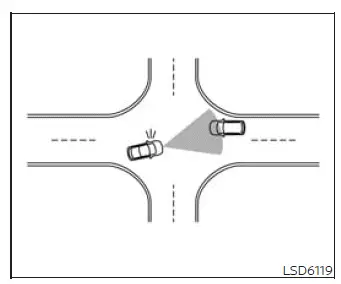
Junction assist for oncoming vehicle
The vehicle's stop lights illuminate whenever the AEB with Pedestrian Detection system applies the brakes, helping alert road users behind the vehicle that it is slowing.
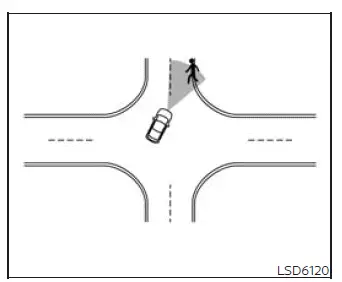
Junction assist for pedestrian
When the AEB with Pedestrian Detection system identifies an obstacle in the projected path and displays a warning, a sound may be heard from the front of the vehicle. This can occur as the braking system prepares for a faster response if braking assistance becomes necessary.
If the system detects a risk of a forward collision, it first warns the driver by flashing the yellow vehicle ahead detection indicator in the vehicle information display and sounding an audible alert. If the driver responds by braking quickly and firmly, but the system determines that a collision risk remains, it can automatically increase the applied braking force.
If the driver does not respond to the initial warning, the system provides a second warning through a flashing red-and-white visual alert and an additional audible warning. If the driver releases the accelerator pedal, partial braking may be applied. When the risk of collision becomes imminent, the system can automatically apply stronger braking to reduce vehicle speed.
Brake operation may produce an audible mechanical sound while the AEB with Pedestrian Detection system is active. This is a normal characteristic of the braking process and does not indicate that the system has malfunctioned.
NOTE: The brake lights illuminate whenever the AEB with Pedestrian Detection system applies any level of automatic braking.
Depending on the speed of the Nissan Murano, the distance to the vehicle or pedestrian ahead, and the current traffic, road, and driving conditions, the system may help avoid a forward collision or reduce its severity when a collision cannot be prevented.
If the driver is actively steering, accelerating, or braking, AEB with Pedestrian Detection may respond later than expected or may not operate. The driver's control inputs take priority and can affect the timing and level of automatic intervention.
Automatic braking stops under any of the following conditions:
- When the driver turns the steering wheel to avoid the detected collision risk.
- When the accelerator pedal is pressed.
- When the system no longer detects a vehicle or pedestrian in the forward path.
If the AEB with Pedestrian Detection system brings the vehicle to a stop, the brakes remain applied for approximately 2 seconds before they are released. The driver must press the brake pedal as necessary to keep the vehicle stationary.
See also:
3rd row bench seat adjustment
Reclining
To recline the seatback, pull up on the latch
located on the outside corner of each seatback.
Lean back until the desired angle is obtained.
To bring the seatback forward again, pull ...
Break-in schedule
During the first 1,200 miles (2,000 km), follow these recommendations to obtain
maximum engine performance and ensure the future reliability and economy of your
new vehicle. Failure to follow th ...
Mechanical key
To remove the mechanical key, release the lock
knob at the back of the key.
To install the mechanical key, firmly insert it into
the key until the lock knob returns to the lock
position.
Us ...