
System malfunction
If the I-FCW system detects a malfunction, it will switch off automatically. A warning chime will sound, the “Malfunction See Owner’s Manual” message will appear in the vehicle information display, and the AEB with Pedestrian Detection warning light will illuminate in orange. While these warnings are active, the Nissan Murano’s Intelligent Forward Collision Warning function may not be available to alert the driver to potential hazards ahead.
Action to take
If the orange warning light illuminates, stop the vehicle in a safe location, turn off the engine, and then restart it. After restarting the engine, check whether the warning light and malfunction message have disappeared. If the warning light remains illuminated or the message appears again, have the I-FCW system inspected. It is recommended that you visit a NISSAN dealer for this service.
System maintenance
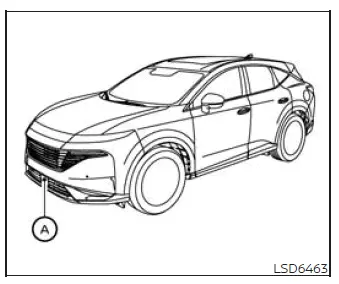
Basic Information
Sensor A is located at the front of the vehicle. Because the I-FCW system relies on this sensor to monitor conditions ahead, the surrounding area must remain clean, unobstructed, and free from damage that could interfere with radar operation.
To support proper system operation and reduce the possibility of a failure or malfunction, observe the following precautions:
- Always keep the sensor area of the front bumper and emblem clean. Remove dirt, mud, snow, ice, or other material that could obstruct the sensor.
- Do not strike, press against, or damage the sensor or the surrounding areas. Damage near the sensor may affect the I-FCW system’s ability to operate correctly.
- Do not cover the sensor area or attach stickers, decorative film, labels, or similar objects to the front bumper near the sensor. Any obstruction in this area could cause improper operation, a system failure, or a malfunction warning.
- Do not install metallic objects, including a brush guard or similar accessories, near the sensor area. Metal positioned in front of or close to the sensor may interfere with radar signals and prevent reliable system operation.
- Do not modify, remove, or paint the front bumper in a way that could affect the sensor area. Before customizing, repairing, repainting, or restoring the Nissan Murano front bumper, it is recommended that you consult a NISSAN dealer.
Radio frequency statement For USA
This device complies with Part 15 of the FCC Rules.
Operation is subject to the following two conditions:
1. This device may not cause harmful interference, and
2. This device must accept any interference received, including interference that may cause undesired operation.
FCC Warning
Changes or modifications to this equipment that are not expressly approved by the party responsible for compliance could void the user’s authority to operate the equipment.
This equipment has been tested and determined to comply with the limits established for a Class A digital device under Part 15 of the FCC Rules. These limits are intended to provide reasonable protection against harmful interference when the equipment is operated in a commercial environment. The equipment generates, uses, and may radiate radio frequency energy. If it is not installed and operated in accordance with the instruction manual, it may cause harmful interference to radio communications. Operation of this equipment in a residential area is likely to produce harmful interference, in which case the user will be responsible for correcting the interference at their own expense.
Radio frequency radiation exposure information: This equipment complies with the FCC radiation exposure limits established for use in an uncontrolled environment.
This equipment must be installed and operated while maintaining a minimum distance of 20 cm between the radiator and the user’s body. This separation distance should be maintained during normal operation of the equipment.
The transmitter must not be installed in the same location as another antenna or transmitter and must not be operated together with any other antenna or transmitter.
For Canada
This device complies with the applicable Industry Canada licence-exempt RSS standard or standards. Operation is permitted only when the following two conditions are satisfied:
1. This device may not cause interference, and
2. This device must accept any interference it receives, including interference that may cause undesired or unintended operation of the device.
Radio frequency radiation exposure information:
This equipment complies with the FCC and IC radiation exposure limits established for an uncontrolled environment. These requirements apply to the radio-frequency equipment associated with the Nissan Murano system.
This equipment must be installed and operated while maintaining a minimum distance of 30 cm between the radiator and the user’s body. The specified distance must be preserved whenever the equipment is operating.
This transmitter must not be co-located with another antenna or transmitter and must not operate in conjunction with any other antenna or transmitter.
FCC Notice
Any changes or modifications to this equipment that are not expressly approved by the party responsible for regulatory compliance could void the user’s authority to operate the equipment installed in the Nissan Murano.
See also:
Changing engine oil and filter
Change the engine oil and filter according to the
maintenance log shown in the NISSAN Service
and Maintenance Guide.
Vehicle set-up
1. Park the vehicle on a level surface and apply
the parking ...
Fuel recommendation
Hardtop models
Use unleaded regular gasoline with an octane
rating of at least 87 AKI (Anti-Knock Index)
number (Research octane number 91).
CrossCabriolet models
NISSAN recommends the use of u ...
Variable voltage control system. Drive belt. Spark plugs. Air cleaner
Variable voltage control system
CAUTION
Do not connect the ground wire of an electrical accessory directly to the battery terminal. A direct
battery connection can bypass the var ...