
Repairing a flat tire (models with emergency tire puncture repair kit)
Basic information
WARNING
- After using Genuine NISSAN Emergency Tire Sealant to temporarily repair a minor puncture, do not drive the Nissan Murano faster than 50 mph (80 km/h). Exceeding this speed may affect the stability of the temporary repair and increase the risk of sudden tire pressure loss.
- Immediately after using Genuine NISSAN Emergency Tire Sealant, it is recommended that you visit a NISSAN dealer to have the affected tire professionally inspected and permanently repaired or replaced. The sealant provides only a temporary solution and cannot permanently seal a punctured tire. Continuing to drive without completing a permanent repair may result in tire failure, loss of vehicle control, and a crash.
- If Genuine NISSAN Emergency Tire Sealant has been used to repair a minor puncture, it is recommended that you visit a NISSAN dealer to have the TPMS sensor replaced in addition to having the tire repaired or replaced. Inform the service personnel that sealant was introduced into the tire so the affected components can be inspected appropriately.
- NISSAN recommends using only the Genuine NISSAN Emergency Tire Sealant supplied with the vehicle. Other sealant products may damage the valve stem seal, which can allow air to escape and cause the tire pressure to decrease.
The Nissan Murano covered by this section is not equipped with a spare tire. Instead, the vehicle is supplied with an emergency tire puncture repair kit containing Genuine NISSAN Emergency Tire Sealant.
The kit is intended only for the temporary repair of certain minor tire punctures. It allows the vehicle to be moved carefully to a location where the damaged tire can be inspected and properly repaired or replaced.
Whenever possible, have the vehicle towed to a qualified facility that can repair or replace the flat tire. Towing avoids placing additional stress on a damaged tire and is the preferred option when the condition or location of the puncture makes temporary repair uncertain.
Using the emergency tire puncture repair kit may affect the tire pressure sensor, cause the monitoring system to malfunction, or illuminate the low tire pressure warning light. The warning may remain active even after the tire has been temporarily inflated because sealant can interfere with the sensor.
CAUTION
- To help prevent damage to the emergency tire puncture repair kit during storage or operation, observe the
following precautions:
- Use the emergency tire puncture repair kit only with your Nissan Murano. Do not use the supplied kit to service tires on another vehicle.
- Use the kit only to inflate the tires installed on this vehicle and to check their tire pressure. Do not use the compressor for unrelated purposes.
- Connect the compressor only to a 12-volt DC vehicle power outlet. Using another type of power source may damage the compressor or prevent it from operating correctly.
- Keep the kit, compressor, hose, and sealant container free from water, dirt, and other contamination that could interfere with their operation.
- Do not disassemble, alter, or modify any part of the emergency tire puncture repair kit.
- Do not drop the kit or expose it to strong impacts. Physical damage may affect the compressor, container, fittings, or other components and make the kit unsafe or unusable.
- Do not use the emergency tire puncture repair kit under any of the conditions listed below. In these
situations, it is recommended that you contact a NISSAN dealer or professional roadside assistance
rather than attempting a temporary repair:
- When the sealant has passed the expiration date printed on the label attached to the bottle. Expired sealant may not provide an effective temporary repair.
- When the cut or puncture is approximately 0.25 in (6 mm) long or larger, because the sealant may not be able to close the damaged area.
- When the sidewall of the tire is damaged. The repair kit is not designed to seal sidewall cuts, tears, or punctures.
- When the vehicle has been driven with extremely low tire pressure, as the tire may have sustained damage that cannot be repaired safely with sealant.
- When the tire has separated from either the inner or outer edge of the wheel. The tire must remain correctly seated on the wheel for the repair kit to be used.
- When the wheel itself is damaged, because adding sealant and air will not correct damage to the wheel.
- When two or more tires are flat. The emergency repair kit is not intended to restore multiple damaged tires.
If a tire on your Nissan Murano becomes flat and none of the conditions that prohibit use of the repair kit are present, follow the instructions below carefully to perform a temporary puncture repair.
Stopping the vehicle
1. Reduce speed gradually and move the Nissan Murano completely off the roadway to a location safely separated from passing traffic. Avoid stopping where the vehicle would obstruct traffic or leave insufficient space to work around the affected tire.
2. Turn on the hazard warning flashers immediately to alert approaching drivers that the vehicle is stopped because of an emergency.
3. Park on a firm, level surface and apply the parking brake securely. Press the park button to place the shift position in P (Park), and confirm that the vehicle is fully stationary before proceeding.
4. Turn off the engine. Do not attempt to use the emergency tire puncture repair kit while the engine is running unless instructed during a later step of the repair procedure.
5. Raise the hood to provide an additional warning to other road users and to help professional roadside assistance personnel recognize that you need help.
6. Ask all passengers to exit the vehicle and wait in a safe location away from traffic. They should remain clear of the Nissan Murano and the area where the tire repair will be performed.
WARNING
- Make sure the parking brake is securely applied and the shift position is placed in P (Park) before beginning the repair procedure. Failure to secure the vehicle may allow it to move unexpectedly.
- Never attempt to repair a tire while the vehicle is positioned on a slope, ice, or another slippery or unstable surface. These conditions are hazardous because the vehicle may shift or roll while you are working.
- Do not begin the tire repair procedure when approaching traffic is passing close to the vehicle or when there is not enough room to work safely. Remain in a protected location and wait for professional roadside assistance.
Getting emergency tire puncture repair kit
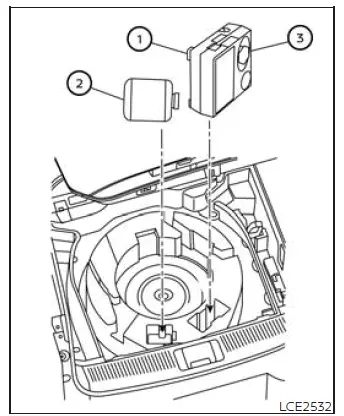
Remove the emergency tire puncture repair kit from its storage location in the cargo area. Place the kit on a stable, clean surface where all components can be reached easily. The repair kit contains the following items:
- Air compressor*
- Tire sealant bottle
- Speed restriction sticker
* The appearance and shape of the air compressor may differ depending on the Nissan Murano model and equipment configuration.
NOTE: Models equipped with the emergency tire puncture repair kit do not include a spare tire, jack, or jack rod as standard equipment.
Before using emergency tire puncture repair kit
- If a foreign object, such as a screw or nail, remains embedded in the tire, do not pull it out. Leaving the object in place may help limit air and sealant loss while the temporary repair is being completed.
- Check the expiration date printed on the label attached to the tire sealant bottle before opening or using it. Never use sealant after its stated expiration date, because it may no longer provide an effective temporary repair.
Repairing tire
WARNING Observe all of the following precautions when handling and using the tire repair compound.
- Swallowing the repair compound is dangerous. If it is swallowed, immediately drink as much water as possible and obtain prompt medical assistance.
- If the compound comes into contact with the skin or eyes, rinse the affected area thoroughly with plenty of clean water. Seek prompt medical attention if irritation continues after rinsing.
- Keep the tire repair compound and all repair kit components out of the reach of children at all times.
- The emergency repair compound may interfere with the tire pressure sensor and cause the low tire pressure warning light to illuminate. Have the affected tire pressure sensor replaced as soon as possible after using the sealant.
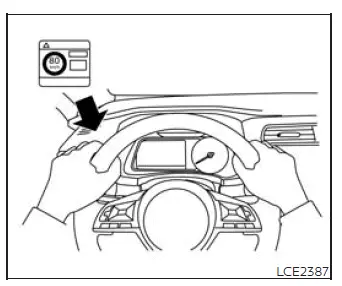
1. Remove the speed restriction sticker from the air compressor. Attach it in a location where the driver can see it clearly while operating the vehicle, so the temporary driving-speed limitation remains visible after the tire has been repaired.
CAUTION Do not attach the speed restriction sticker to the steering wheel pad, the speedometer, or any warning light area. The sticker must not obstruct vehicle controls, instruments, warning indicators, or the steering wheel air bag cover.
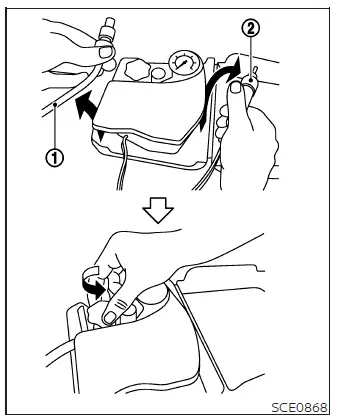
2. Remove the hose 1 and power plug 2 from their storage positions on the air compressor. Then remove the cap from the compressor's bottle holder so the tire sealant bottle can be installed.
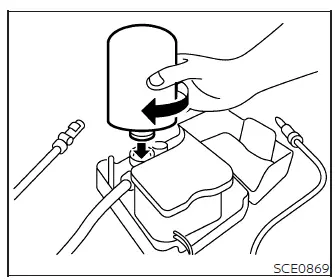
3. Remove the outer cap from the tire sealant bottle, but do not break or remove the seal beneath it before attaching the bottle to the compressor.
Screw the sealant bottle clockwise into the bottle holder. Continue turning it securely so the holder pierces the bottle seal and prepares the sealant for injection into the damaged tire.
4. Remove the valve cap from the flat tire and place it where it will not be lost during the repair procedure.
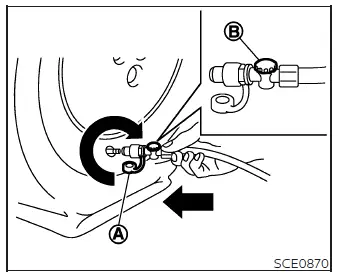
5. Remove protective cap A from the end of the compressor hose, and screw the hose securely onto the tire valve. Confirm that the connection is tight and that pressure release valve B is fully closed before operating the compressor.
Make sure the air compressor switch is set to the OFF (O) position. After confirming that the compressor is switched off, insert the power plug into the appropriate power outlet in the Nissan Murano.
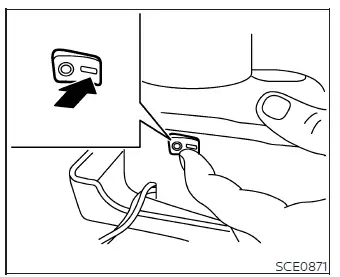
6. Push the vehicle power switch to the ACC position.
Turn the compressor switch to the ON (−) position and begin inflating the tire. If possible, inflate it to the pressure specified on the Tire and Loading Information label attached to the driver-side center pillar. If the specified pressure cannot be reached, inflate the tire to at least 26 psi (180 kPa). Briefly switch the air compressor off when checking the pressure shown on the gauge.
If the tire pressure rises above the specified value, reduce it by carefully releasing air through the pressure release valve. Recheck the gauge after releasing air to confirm that the pressure has been adjusted correctly.
NOTE: During the first approximately 30 seconds of inflation, the compressor pressure gauge may display a reading as high as 87 psi (600 kPa). At this stage, the gauge is showing the pressure inside the sealant container rather than the actual tire pressure. After the sealant has entered the tire, the indicated pressure will decrease and the gauge will begin showing the tire's actual inflation pressure.
WARNING Observe the following precautions to reduce the risk of serious personal injury while operating the emergency tire puncture repair kit:
- Tighten the compressor hose securely onto the tire valve before switching on the compressor. A loose connection may allow tire sealant to spray into the air and come into contact with the eyes or skin.
- Do not stand directly beside the damaged tire while it is being inflated, because a weakened tire may rupture. If you notice cracks, bulges, or other unusual deformation, switch off the compressor immediately and move away from the tire.
If the tire pressure does not reach 26 psi (180 kPa) within 10 minutes, the tire may be too severely damaged for temporary repair with this kit. Stop using the compressor and contact a NISSAN dealer for assistance.
7. When the tire reaches the specified pressure, switch off the air compressor. If the specified pressure cannot be achieved but the tire has reached at least 26 psi (180 kPa), the compressor may be switched off at that point. Disconnect the power plug from the vehicle's power outlet, and promptly unscrew the hose from the tire valve to limit pressure loss. Reinstall the hose protective cap and the tire valve cap, then return the complete emergency tire puncture repair kit to its designated storage location in the Nissan Murano cargo area.
CAUTION To reduce the risk of serious personal injury when storing the emergency tire puncture repair kit, observe the following precaution:
- Keep the sealant bottle securely screwed into the compressor while the kit is being handled and returned to storage. Removing the bottle at this stage may allow sealant to spray into the air and come into contact with your eyes or skin.
8. Immediately drive the Nissan Murano for approximately 10 minutes or 2 miles (3 km), keeping the vehicle speed below 50 mph (80 km/h). This driving period allows the sealant to spread through the tire and reach the punctured area.
9. After driving, stop the vehicle in a safe location and confirm that the air compressor switch is in the OFF position. Screw the compressor hose securely onto the tire valve, then use the pressure gauge to check the tire pressure. The temporary repair is considered complete only if the measured pressure has not decreased.
Before continuing to drive, adjust the tire pressure to the value specified on the Tire and Loading Information label. Do not rely on the temporary repair until the pressure has been checked and corrected as required.
10. If the tire pressure has decreased, repeat steps 5 through 9. If the pressure drops again or falls below 19 psi (130 kPa), the tire cannot be repaired with the emergency tire puncture repair kit. Do not continue driving the Nissan Murano on the damaged tire. Have the vehicle towed to the nearest dealership.
The used sealant bottle and hose cannot be reused to repair another punctured tire. Both components must be replaced before the emergency repair kit can be prepared for future use.
It is recommended that you visit a NISSAN dealer to purchase the correct replacement sealant bottle and hose.
After tire repair
Visit a NISSAN dealer as soon as possible to have the damaged tire professionally inspected and permanently repaired or replaced. The emergency sealant provides only a temporary repair and is not intended to restore the tire for continued normal use.
WARNING
- After using Genuine NISSAN Emergency Tire Sealant to temporarily repair a minor puncture, do not drive the Nissan Murano at speeds above 50 mph (80 km/h). Keep the speed restriction in effect until the tire has been permanently repaired or replaced.
- Immediately after using Genuine NISSAN Emergency Tire Sealant, it is recommended that you visit a NISSAN dealer. The sealant cannot permanently close a punctured tire. Continuing to operate the vehicle without a permanent tire repair may lead to tire failure, loss of vehicle control, and a crash.
- Genuine NISSAN Emergency Tire Repair Sealant, if equipped, or an equivalent approved product may be used for temporary tire repair. Do not inject any other type of tire sealant into the tires, because an unsuitable product may cause the tire pressure sensors to malfunction.
- If Genuine NISSAN Emergency Tire Sealant has been used to repair a minor puncture, it is recommended that you visit a NISSAN dealer to have the TPMS sensor replaced when the tire is repaired or replaced.
- NISSAN recommends using only the Genuine NISSAN Emergency Tire Sealant supplied with the vehicle. Other sealants may damage the valve stem seal, allowing air to escape and causing the tire to lose pressure.
See also:
Audio system
Audio operation precautions
Radio
Place the ignition switch to the ACC or ON position and push the radio band select
button to turn on the radio. If you listen to the radio with the engine not run ...
Jump starting
To start your engine with a booster battery, the
instructions and precautions below must be
followed.
WARNING
• If done incorrectly, jump starting
can lead to a battery explosion,
resulting in ...
Opening the top using the Intelligent Key
The soft top can be opened using the door
handle request switch.
Opening the soft top
Push the ignition switch to the OFF position and
make sure to carry the Intelligent Key with you.
Make su ...