
Engine cooling system
Basic information
The engine cooling system in the Nissan Murano is factory-filled with a pre-diluted mixture consisting of 50% Genuine NISSAN Long Life Antifreeze/Coolant (blue) and 50% water. This balanced mixture provides year-round protection against freezing and overheating while supporting proper cooling system operation in a wide range of temperatures.
The antifreeze and coolant solution already contains inhibitors designed to protect internal cooling system components against rust and corrosion. No additional cooling system additives are required or recommended.
WARNING
- Never remove the radiator cap or coolant reservoir cap while the engine is hot. Wait until both the engine and radiator have cooled completely before opening either cap. Hot coolant remains under pressure and may escape suddenly, causing serious burns.
- The radiator uses a pressure-type cap designed for the cooling system. To help prevent overheating or engine damage, use only a Genuine NISSAN radiator cap of the correct type.
CAUTION
- Never add radiator sealer or any other cooling system additive. Such products may restrict coolant passages, clog the system, and damage the engine, transmission, or cooling system components.
- When adding or replacing engine coolant, use only Genuine NISSAN Long Life Antifreeze/Coolant (blue) or an equivalent product. Genuine NISSAN Long Life Antifreeze/Coolant (blue) is pre-diluted to provide freeze protection down to -34º F (-37º C). If greater freeze protection is required because of the climate in which the Nissan Murano is operated, add Genuine NISSAN Long Life Antifreeze/Coolant (blue) concentrate according to the instructions printed on the container. When using an equivalent coolant, follow the coolant manufacturer's directions to maintain protection to at least -34º F (-37º C). Coolant formulations other than Genuine NISSAN Long Life Antifreeze/Coolant (blue) or an approved equivalent may damage the engine cooling system.
- The factory-fill coolant has an expected service life of 105,000 miles (168,000 km) or 7 years. Mixing it with another coolant type, including Genuine NISSAN Long Life Antifreeze/Coolant (green), or adding non-distilled water may shorten that service life and affect cooling system protection. Refer to the "Maintenance and schedules" section of this manual for the applicable replacement information.
Checking engine coolant level
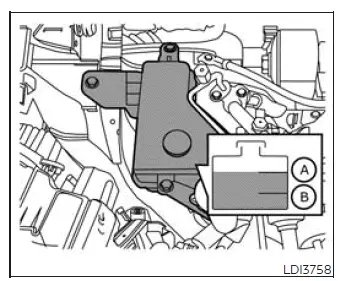
Check the coolant level in the reservoir only when the engine is cold. If the level is below the MIN mark B, add the correct coolant until it reaches the MAX mark A. Do not fill the reservoir above the indicated maximum level.
If the coolant reservoir is empty, allow the engine to cool completely and then check the coolant level inside the radiator. When the radiator does not contain enough coolant, fill it to the filler opening and add coolant to the reservoir until the level reaches the MAX mark A.
The Nissan Murano is filled with Genuine NISSAN Long Life Antifreeze/Coolant (blue) at the factory. Its expected service life is 105,000 miles (168,000 km) or 7 years. Mixing the factory coolant with another coolant formulation or using non-distilled water may reduce its effective service life. Refer to the "Maintenance and schedules" section of this manual for additional maintenance details.
If the cooling system requires coolant frequently, have the system inspected for the cause of the coolant loss. It is recommended that you visit a NISSAN dealer for this service.
Changing engine coolant
A NISSAN dealer can replace the engine coolant using the correct service procedure. Detailed instructions for performing this work are provided in the NISSAN Service Manual.
Incorrect coolant replacement or incomplete servicing may reduce heater performance and cause the Nissan Murano engine to overheat.
WARNING
- To avoid being burned or scalded, never attempt to change the engine coolant while the engine or cooling system is hot.
- Never remove the radiator cap or engine coolant reservoir cap while the engine is hot. Pressurized coolant may escape forcefully and cause serious burns.
- Avoid direct contact between used coolant and your skin. If contact occurs, wash the affected area thoroughly with soap or an appropriate hand cleaner as soon as possible.
- Store new and used coolant safely out of the reach of children and pets.
Used engine coolant must be collected and disposed of properly to prevent environmental contamination.
Follow all applicable local regulations governing the disposal or recycling of automotive coolant.
See also:
RearView monitor (if so equipped)
When the selector lever is shifted into the R (Reverse) position, the monitor
display shows the view to the rear of the vehicle.
The system is designed as an aid to the driver in detecting large st ...
Sun visors
1 To block glare from the front, swing down the
sun visor.
2 To block glare from the side, remove the sun
visor from the center mount and swing the
visor to the side.
3 Slide the extension ...
Basic Information. MOD system operation
Basic Information
Display screen used to show the available camera views, MOD status icons, and visual detection frames.
CAMERA button used to activate the camera display and access t ...