
Tire pressure
Tire Pressure Monitoring System (TPMS)
WARNING Radio waves could adversely affect electric medical equipment.
Anyone who uses a pacemaker should contact the manufacturer of the electric medical equipment before using the vehicle to determine whether radio-frequency signals could affect the device.
The Nissan Murano is equipped with a Tire Pressure Monitoring System (TPMS) designed to monitor the inflation pressure of the road tires while the vehicle is being driven.
The TPMS monitors the pressure of all installed tires except the spare tire. When the low tire pressure warning light illuminates and the “Tire Pressure Low - Add Air” warning appears in the vehicle information display, one or more tires are significantly underinflated and should be checked as soon as it is safe to do so. If equipped, the system can also display the individual pressure of each road tire on the display screen. This information is transmitted by a pressure sensor installed in each wheel.
The TPMS becomes active only when the vehicle is driven at speeds above 16 mph (25 km/h). Because the system requires vehicle movement and sensor data to operate, it may not immediately detect every pressure change. It may also be unable to provide advance warning of a sudden loss of air, such as a tire becoming flat while the Nissan Murano is being driven.
Tire inflation pressure
Check the pressure of all tires, including the spare tire, regularly and always before beginning a long-distance trip. Correct inflation supports stable handling, normal tire wear, and dependable vehicle operation. The recommended tire pressure specifications are listed on the F.M.V.S.S./C.M.V.S.S. certification label or on the Tire and Loading Information label under the “Cold Tire Pressure” heading.
The Tire and Loading Information label is attached to the driver-side center pillar. Use the pressure values printed on the applicable vehicle label rather than relying on the pressure molded into the tire sidewall, which does not replace the vehicle manufacturer’s recommended inflation specification.
Tire pressures should be checked regularly because:
- Most tires naturally lose a small amount of air over time, even when there is no visible puncture or damage.
- A tire can lose air suddenly after the vehicle is driven over a pothole or another road object, or when a wheel or tire strikes a curb while parking.
Tire pressure should be measured when the tires are cold. Tires are considered COLD after the vehicle has been parked for 3 hours or more, or after it has been driven less than 1 mile (1.6 km) at a moderate speed. Checking pressure under these conditions provides a more accurate comparison with the specified cold tire pressure shown on the vehicle label.
The TPMS with Easy-Fill Tire Alert provides visual and audible signals outside the vehicle while the tires are being inflated. These signals assist in bringing each applicable tire to the recommended COLD tire pressure without requiring repeated checks inside the Nissan Murano.
Incorrect tire pressure, including underinflation, may adversely affect tire service life, vehicle handling, braking response, and overall driving stability.
WARNING
- Improperly inflated tires can fail suddenly, cause the driver to lose control of the vehicle, and result in an accident.
- The Gross Vehicle Weight Rating (GVWR) is listed on the F.M.V.S.S./C.M.V.S.S. certification label. The
permitted vehicle load capacity is shown on the Tire and Loading Information label.
Do not load the vehicle beyond the specified capacity. Overloading may shorten tire life, create unsafe operating conditions due to premature tire failure, and adversely affect steering and handling. These conditions could cause the driver to lose control and may result in a serious accident.
Loading the vehicle beyond its specified capacity may also place excessive stress on other vehicle components and lead to component damage or failure.
- Before starting a long trip, or whenever the vehicle will be carrying a heavy load, use an accurate tire pressure gauge to verify that every tire is inflated to the specified pressure. Adjust the pressures while the tires are cold.
- For further information about tire use, inspection, maintenance, and safety, refer to “Important Tire Safety Information” for the United States or “Tire Safety Information” for Canada in the Warranty Information Booklet.
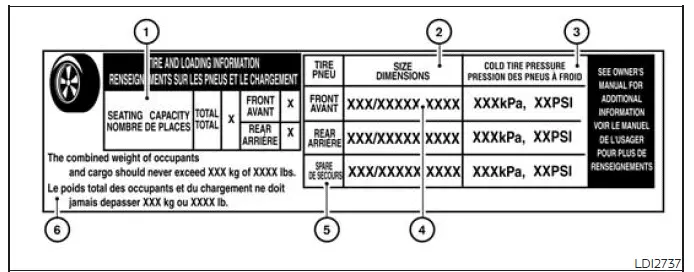
Tire and Loading Information label
- Seating capacity: Indicates the maximum number of occupants who may be seated in the vehicle. This figure should be considered together with the vehicle load limit when carrying passengers and cargo in the Nissan Murano.
- Tire size: Identifies the specified tire dimensions for the vehicle. For an explanation of the letters, numbers, and other markings used in the tire designation, see "Tire labeling".
- Cold tire pressure: Shows the pressure to which the tires should be inflated when they are cold. Use the listed value when checking or adjusting tire pressure under the specified cold-tire conditions.
Tires are considered COLD after the vehicle has been parked for 3 hours or more, or after it has been driven less than 1 mile (1.6 km) at moderate speeds. The recommended cold tire inflation pressure is established by the manufacturer to provide an appropriate balance of tire wear, vehicle handling, driveability, and tire noise while the vehicle is operated within its Gross Vehicle Weight Rating (GVWR). Always use the pressure values shown on the Nissan Murano Tire and Loading Information label for the applicable tire size.
- Original tire size: Identifies the size of the tires installed on the vehicle at the factory. Replacement tires should be verified against this information and the applicable tire specifications.
- Spare tire size: Lists the specified size of the spare tire, when the vehicle is equipped with one.
- Vehicle load limit: Shows the maximum permitted combined load for occupants and cargo. For a detailed explanation of how this limit applies, see "Vehicle loading information".
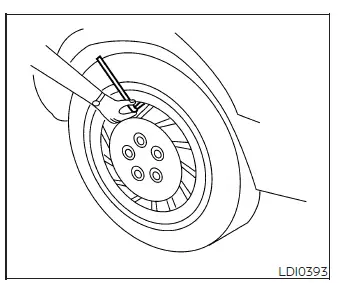
Checking tire pressure
1. Remove the valve stem cap from the tire and place it in a secure location so it is not lost during the pressure check.
2. Press the tire pressure gauge squarely and firmly onto the valve stem. Do not press excessively or push the valve stem sideways, because an improper seal between the gauge and the valve may allow air to escape and produce an inaccurate reading.
If a hissing sound is heard while the pressure is being checked, air is escaping around the gauge connection. Remove and reposition the gauge directly over the valve stem until the leakage stops and a stable reading can be obtained.
3. Remove the gauge from the valve stem after the pressure reading has been registered.
4. Read the tire pressure indicated on the gauge stem and compare it with the specification shown on the Tire and Loading Information label. Confirm that the tire size being checked corresponds to the pressure value listed on the label.
5. Add air to the tire as necessary. If too much air has been added, briefly press the valve stem core with the tip of the gauge stem to release a small amount of pressure. Check the pressure again and continue adding or releasing air until the specified value is reached.
6. Reinstall the valve stem cap securely after the pressure has been adjusted. The cap helps protect the valve stem from dirt, moisture, and debris.
7. Repeat the procedure for all remaining tires, including the spare tire. Checking every tire helps maintain consistent inflation across the Nissan Murano and ensures that the spare is ready for use if required.
Size/Cold Tire Inflation Pressure:
Front and Rear Original Tire
- 255/55R20
- 35 psi
- 240 kPa
Front and Rear Original Tire
- 255/50R21
- 35 psi
- 240 kPa
Spare Tire (if so equipped)
- T175/90D18
- 60 psi
- 420 kPa
See also:
Instrument brightness control
Push the “+” button A to increase the brightness
of instrument panel lights when driving at
night.
Push the “-” button B to decrease the brightness
of instrument panel lights when driv ...
Basic Information
The Traffic Sign Recognition (TSR) system provides the driver with information about the most recently detected
speed limit. A multi-sensing front camera unit A, mounted on the windshield in fro ...
Speedometer and odometer
Speedometer
The speedometer indicates vehicle speed.
Odometer/Twin trip odometer
The odometer 1 and the twin trip odometer 2
are displayed below the Vehicle Information Display
when the ignitio ...