
Changing wheels and tires
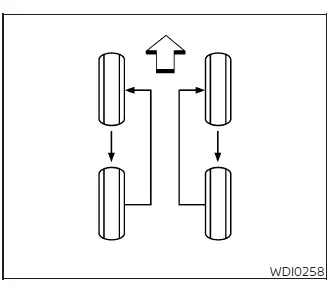
Tire rotation
NISSAN recommends rotating the tires every 7,500 miles (12,000 km). Regular rotation helps distribute tread wear more evenly among all four tires and supports consistent handling throughout the tire service life.
As soon as possible after the wheels have been installed or repositioned, tighten the wheel nuts to the specified torque using a properly calibrated torque wrench.
Wheel nut tightening torque: 83 ft-lb (113 N·m)
The wheel nuts must remain tightened to the specified torque at all times. Incorrectly tightened wheel nuts may loosen during driving or place uneven stress on the wheel and mounting components.
It is recommended that the wheel nut torque be checked and adjusted to specification at every tire rotation interval. Tighten the nuts evenly and verify the final torque with a torque wrench.
WARNING
- After rotating the tires, check the inflation pressure of all four tires and adjust each one to the specified cold tire pressure for the Nissan Murano.
- Retighten the wheel nuts after the vehicle has been driven for 600 miles (1,000 km). This requirement also applies after replacing a flat tire or whenever a wheel has been removed and reinstalled.
- Do not include the spare tire in the regular tire rotation pattern.
- For further information about tire inspection, maintenance, and safe use, refer to “Important Tire Safety Information” for the United States or “Tire Safety Information” for Canada in the Warranty Information Booklet.
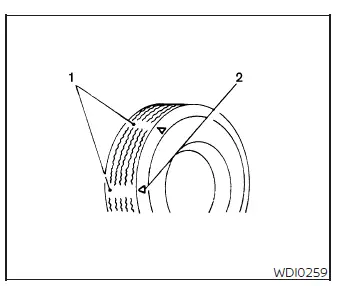
Tire wear and damage
- Wear indicator
- Location mark
The built-in wear indicators are positioned across the tire tread, while the corresponding location marks on the sidewall help identify where the indicators can be found. Inspect these areas carefully when evaluating tire condition.
WARNING
- Inspect the tires periodically for uneven or excessive tread wear, cracking, bulges, deep cuts, and stones, nails, or other objects embedded in the tread. If excessive wear, structural cracking, bulging, or deep damage is found, replace the affected tire or tires before continuing normal vehicle operation.
- The original tires are manufactured with built-in tread wear indicators. When an indicator becomes visible and is level with the surrounding tread surface, the tire has reached its wear limit and should be replaced.
- Tires deteriorate as a result of age as well as use. Have every tire, including the spare, inspected by a qualified technician once it is more than 6 years old, because internal deterioration or other damage may not be immediately visible. Replace aged or damaged tires as necessary to reduce the risk of sudden tire failure, loss of vehicle control, serious personal injury, or death.
- Improper inspection, repair, or servicing of the spare tire may result in tire failure and could cause serious personal injury or death. If the spare tire requires repair or professional evaluation, it is recommended that you visit a NISSAN dealer for this service.
- For additional tire maintenance and safety guidance, refer to “Important Tire Safety Information” for the United States or “Tire Safety Information” for Canada in the Warranty Information Booklet.
Replacing wheels and tires
When replacing a tire, select one with the same size, tread design, speed rating, and load-carrying capacity as the tire originally installed on the Nissan Murano. Matching these specifications helps preserve the vehicle characteristics for which the wheel, tire, and related systems were designed.
WARNING
- Using tires other than those recommended, or combining tires of different brands, construction types such as bias, bias-belted, or radial, or different tread patterns, may adversely affect ride quality, braking, steering response, handling, Vehicle Dynamic Control (VDC) operation, ground clearance, body-to-tire clearance, tire-chain clearance, speedometer calibration, headlight aim, and bumper height. Any of these changes may contribute to a collision and could result in serious personal injury.
- For 2WD models originally equipped with four tires of the same size, if only two of the four tires are being replaced, install the new tires on the rear axle. Make sure the replacement tires meet the required size, construction, load, and speed specifications.
Installing new tires only on the front axle may reduce rear-wheel traction in certain driving conditions. This can cause the vehicle to become unstable, lead to a loss of control, and result in a collision or personal injury.
- If the wheels are replaced for any reason, always use wheels with the same offset dimension as the original
equipment wheels.
Wheels with a different offset may cause premature or uneven tire wear, alter the handling characteristics of the Nissan Murano, interfere with proper Vehicle Dynamic Control (VDC) operation, or create contact with the brake discs or nearby components. Such interference may reduce braking efficiency, accelerate brake pad wear, and adversely affect safe vehicle operation.
- When a wheel without a Tire Pressure Monitoring System (TPMS) sensor is installed, such as the spare tire, the TPMS will not operate normally. The low tire pressure warning light will flash for approximately 1 minute and will then remain illuminated. Have the regular tire and wheel reinstalled and/or the TPMS reset as soon as possible. It is recommended that you visit a NISSAN dealer for this service.
- Installing replacement tires that were not originally specified by NISSAN may interfere with the correct operation and accuracy of the TPMS. Use tires that meet the applicable size and specification requirements for the Nissan Murano.
- The TPMS sensor can be damaged by improper handling during tire removal, installation, or wheel service. Use care around the valve stem and sensor assembly, and make sure anyone servicing the tire is aware that a TPMS sensor is installed.
- When a TPMS sensor is replaced, registration of the new sensor identification code may be required before the system can monitor the wheel correctly. It is recommended that you visit a NISSAN dealer for sensor ID registration.
- Do not install a valve stem cap that is not specified by NISSAN. An unsuitable cap may corrode, bind, or become stuck on the valve stem, making pressure adjustment or future service difficult.
- Make sure every valve stem cap is installed correctly and tightened securely by hand. A missing or improperly fitted cap can allow dirt, moisture, and road debris to enter the valve area, potentially causing valve malfunction or gradual air-pressure loss.
- Do not install a wheel or tire that is damaged, cracked, bent, or deformed, even if it has previously been repaired. Hidden structural damage may remain and could cause the wheel or tire to fail suddenly without warning.
- The use of retread tires is not recommended because their construction, condition, and performance characteristics may not match those required for the vehicle.
- For additional information about tire selection, inspection, maintenance, and safe operation, refer to “Important Tire Safety Information” for the United States or “Tire Safety Information” for Canada in the Warranty Information Booklet.
Wheel balance
Unbalanced wheels can cause vibration, reduce ride comfort, affect steering and handling, and shorten tire service life through uneven tread wear. Wheels may gradually lose their proper balance during normal use as the tires wear or after contact with potholes and other road hazards. For this reason, the wheels should be inspected and balanced whenever vibration or irregular tire wear is noticed and whenever balancing is otherwise required.
Wheel balance service should be performed with the wheels removed from the vehicle. This allows the wheel and tire assembly to be checked and balanced using the appropriate equipment without placing unnecessary stress on vehicle components.
Do not spin-balance the wheels while they are installed on the Nissan Murano. Balancing the wheels on the vehicle may place excessive loads on the drivetrain or other mechanical components and could result in damage.
- For further tire maintenance and safety information, refer to “Important Tire Safety Information” for the United States or “Tire Safety Information” for Canada in the Warranty Information Booklet.
Care of wheels
- Wash the wheels whenever the vehicle is washed to remove dirt, brake dust, and road residue and to help preserve their appearance and finish.
- Clean the inner surfaces of the wheels whenever a wheel is removed or when the underside of the vehicle is washed. Accumulated dirt in these areas can make inspection more difficult and may affect wheel appearance.
- Do not use abrasive cleaners, harsh brushes, or materials that could scratch or damage the wheel finish. Use suitable wheel-cleaning products and rinse the surfaces thoroughly.
- Inspect the wheel rims regularly for dents, cracks, deformation, or corrosion. Damage around the tire bead seating area may prevent a proper seal and can result in gradual or sudden loss of tire pressure.
- NISSAN recommends applying wax to the road wheels in areas where road salt is used during winter. A protective coating can help reduce the effects of salt, moisture, and other corrosive road contaminants on the Nissan Murano wheels.
Spare tire (TEMPORARY USE ONLY spare tire) (if so equipped)
When a wheel without a Tire Pressure Monitoring System (TPMS) sensor is installed, such as the temporary spare tire, the TPMS cannot monitor that wheel and will not operate normally.
Observe all of the following precautions whenever the TEMPORARY USE ONLY spare tire must be installed. This tire is intended only as a short-term emergency solution. Incorrect use may damage the Nissan Murano, affect its handling, or contribute to an accident:
WARNING
- Use the spare tire only in an emergency. Replace it with the standard wheel and tire at the earliest opportunity to reduce the risk of tire, drivetrain, or differential damage.
- Drive carefully while the TEMPORARY USE ONLY spare tire is installed. Avoid sharp turns, sudden steering inputs, rapid acceleration, and abrupt braking, as the vehicle may respond differently than it does with four standard tires.
- Check the spare tire inflation pressure periodically, including when the tire is not in use. Always maintain the TEMPORARY USE ONLY spare tire at 60 psi (420 kPa, 4.2 bar) so it is ready for emergency installation.
- Do not drive the Nissan Murano faster than 50 mph (80 km/h) while the TEMPORARY USE ONLY spare tire is installed. Reduce speed further whenever road, traffic, or weather conditions require it.
- When driving on snow-covered or icy roads, install the TEMPORARY USE ONLY spare tire on a rear wheel and keep an original tire on each front wheel, which is a drive wheel. If a front tire becomes flat, move a standard rear wheel to the front and install the temporary spare on the rear.
- The tread on the TEMPORARY USE ONLY spare tire wears more quickly than the tread on a standard tire. Replace the spare as soon as its tread wear indicators become visible.
- Do not install this spare tire on another vehicle. It is intended for use only with the vehicle for which it was supplied.
- Do not install or use more than one temporary spare tire on the vehicle at the same time.
- Do not tow a trailer while the TEMPORARY USE ONLY spare tire is installed, because the additional load may adversely affect vehicle stability and place excessive stress on the temporary tire.
CAUTION
- Do not install tire chains on the TEMPORARY USE ONLY spare tire. Chains will not fit the smaller tire correctly and may contact or damage the wheel well, suspension, brake components, or other parts of the vehicle.
- Because the TEMPORARY USE ONLY spare tire is smaller than the original tire, the ground clearance of the
Nissan Murano is reduced.
To prevent underbody or component damage, avoid driving over curbs, deep potholes, raised surfaces, and other obstacles. Do not drive the vehicle through an automatic car wash while the temporary spare is installed, because the reduced ground clearance may cause the vehicle to become caught in the wash equipment.
Emergency tire puncture repair kit (if so equipped)
On vehicles supplied without a spare tire, an emergency tire puncture repair kit containing Emergency Tire Sealant is provided instead. The kit may be used to make a temporary repair to certain minor tire punctures so the vehicle can be moved for professional service.
Whenever possible, have the vehicle towed to a qualified repair facility where the damaged tire can be properly inspected, repaired, or replaced. The sealant repair is temporary and does not restore the tire to its original condition.
Using the emergency tire puncture repair kit may interfere with the tire pressure sensor. As a result, the low tire pressure warning light may illuminate and the TPMS may require inspection or service after the tire has been repaired or replaced.
NOTE: Models equipped with the emergency tire puncture repair kit do not include a spare tire, jack, or jack rod as standard equipment.
See also:
Vehicle Identification Number (VIN) plate
The vehicle identification number plate is attached
as shown. This number is the identification
for your vehicle and is used in the vehicle
registration. ...
Warning signals
To help prevent the vehicle from moving
unexpectedly by erroneous operation of the
Intelligent Key listed on the following chart or
to help prevent the vehicle from being stolen,
chime or beep sou ...
Heater and air conditioner
WARNING
• The air conditioner cooling function
operates only when the engine is
running.
• Do not leave children or adults who
would normally require the support
of others alone in your vehi ...