
NISSAN Advanced Air Bag System (front seats)
Basic Information
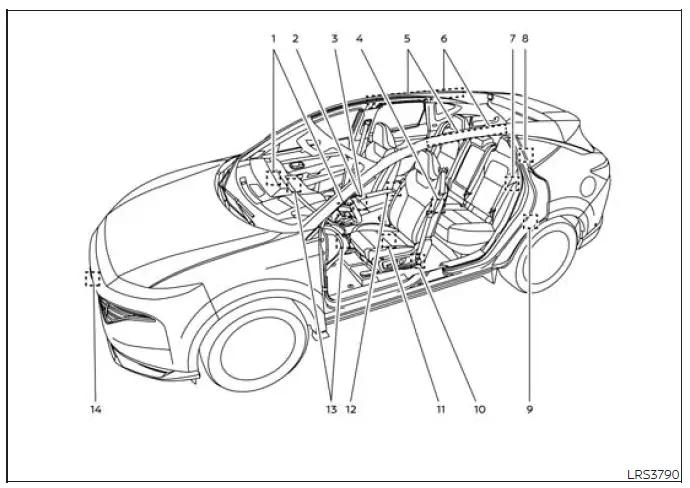
- Supplemental front-impact air bag modules, positioned to help provide additional protection for the driver and front passenger during certain frontal collisions.
- Air bag Control Unit (ACU), which monitors the supplemental restraint system and processes crash-related information from the connected sensors.
- Occupant classification sensors (2) (weight sensors-located on passenger seat frame), used to help the system evaluate the front passenger seat condition.
- Front seat-mounted side-impact supplemental air bag modules (driver's side shown; passenger side similar), designed to deploy from the seat area in certain side-impact situations.
- Roof-mounted curtain side-impact and rollover supplemental air bags, which help provide added coverage along the side window area for occupants in the appropriate seating positions.
- Roof-mounted curtain side-impact and rollover supplemental air bag inflators, installed as part of the curtain air bag system to support proper deployment when activation conditions are met.
- Rear outboard seat-mounted side-impact supplemental air bag modules, located to help supplement occupant protection for rear outboard passengers in certain side-impact events.
- Seat belt with pretensioner(s) (rear outboard seats), which may help tighten the seat belt during specific collision conditions.
- Satellite sensors (driver's side shown; passenger side similar), placed to assist the air bag system in detecting certain impact conditions.
- Seat belt with pretensioner(s) (front seats), integrated into the front seating positions to support the restraint function of the seat belts.
- Pressure sensors in door (driver's side shown; front passenger side similar), used as part of the side-impact detection system.
- Front central seat-mounted side-impact supplemental air bag (if so equipped), included on certain Nissan Murano configurations to help provide additional protection between the front seating positions.
- Driver and front passenger supplemental knee air bags, positioned to help reduce lower-body movement in certain frontal collision conditions.
- Crash zone sensor, located at the front area of the vehicle to support crash detection for the supplemental restraint system.
WARNING To help ensure proper operation of the passenger's NISSAN Advanced Air Bag System in the Nissan Murano, observe the following items carefully. The front passenger occupant classification system depends on the seat area remaining clear, correctly positioned and free from added pressure that could affect sensor readings.
- Do not allow a passenger in the rear bench seats to push, pull or apply pressure to the seatback pocket of the front passenger seat, as this may affect the way the system evaluates the seat.
- Do not place heavy loads heavier than 9 lbs. (4 kg) on the seatback, head restraint/headrest or in the seatback pocket. Extra weight in these areas can create pressure that was not intended as part of normal passenger seating.
- Make sure that there is nothing pressing against the rear of the seatback, such as a child restraint installed in the rear seat or an object stored on the floor. Any object pushing into the seatback may interfere with proper system judgment.
- Make sure that there is no object placed under the front passenger seat. Items stored under the seat can restrict seat movement or affect nearby components related to the occupant classification system.
- Make sure that there is no object placed between the seat cushion and center console or between the seat cushion and the door. Objects wedged into these areas may apply unintended force to the seat cushion or seat frame.
- If a forward-facing child restraint is installed in the front passenger seat, do not position the front passenger seat so the child restraint contacts the instrument panel. If the child restraint does contact the instrument panel, the system may determine the seat is occupied and the passenger air bag and front passenger supplemental knee air bag may deploy in a collision. Also the front passenger air bag status light may not illuminate. Correct positioning is especially important because the Nissan Murano air bag system relies on proper seat and restraint placement to make an accurate classification.
- Confirm the operating condition with the front passenger air bag status light before driving, especially after changing the seat position, installing a child restraint, or moving objects around the front passenger area.
- If you notice that the front passenger air bag status light is not operating as described in this section, get the occupant classification system checked. It is recommended that you visit a NISSAN dealer for this service so the system can be inspected with the proper diagnostic approach.
- Until you have confirmed with a dealer that your passenger seat occupant classification system is working properly, position the occupants in the rear seating positions. This helps reduce the chance of relying on a front passenger air bag status that may not be functioning as intended.
- Do not position the front passenger seat so it contacts the rear seat. If the front seat does contact the rear seat, the air bag system may determine a sensor malfunction has occurred and the front passenger air bag status light may illuminate and the supplemental air bag warning light may flash. In the Nissan Murano, keeping the front passenger seat free from contact with the rear seat helps the system maintain the correct operating condition.
This Nissan Murano is equipped with the NISSAN Advanced Air Bag System for the driver and front passenger seats. The system is engineered to meet certification requirements under U.S. regulations and is also permitted for use in Canada. Even with this advanced supplemental restraint technology, every caution, warning and instruction provided in this manual remains fully applicable and must be followed. The air bag system is designed to work together with proper seating position and correct seat belt use, not as a substitute for them.
The driver supplemental front-impact air bag is located in the center of the steering wheel. The front passenger supplemental front-impact air bag is mounted in the dashboard above the glove box. These front air bags are designed to inflate in higher severity frontal collisions, although they may also inflate if the forces produced by another type of collision are similar to those of a higher severity frontal impact. They may not inflate in certain frontal collisions, depending on the direction, force and characteristics of the impact. Vehicle damage, whether severe or minimal, is not always a reliable indication of proper front air bag system operation, because air bag deployment is determined by crash forces measured by the system rather than by visible exterior damage alone.
The NISSAN Advanced Air Bag System monitors information from the crash zone sensor, the Air bag Control Unit (ACU), seat belt buckle sensors and the occupant classification sensor (weight sensor). Inflator operation is based on the severity of the collision and seat belt usage for the driver. For the front passenger, the occupant classification sensor is also monitored so the system can evaluate conditions at the front passenger seat. Based on information received from these sensors, only one front air bag may inflate in a crash, depending on crash severity and whether the front occupants are belted or unbelted. Additionally, the front passenger air bag and front passenger supplemental knee air bag may be automatically turned off under some conditions, depending on the weight detected on the front passenger seat and how the seat belt is used. If the front passenger air bag and front passenger supplemental knee air bag are OFF, the front passenger air bag status light will be illuminated. In the Nissan Murano, one front air bag inflating by itself does not indicate improper performance of the system, because the system is designed to respond according to the specific information it receives during the event.
If you have any questions about your Nissan Murano air bag system, it is recommended that you visit a NISSAN dealer to obtain accurate information about the system and its operation. If you are considering modification of your vehicle due to a disability, you may also contact NISSAN before making changes that could affect seating, restraint components or air bag performance. Contact information is contained in the front of this Owner's Manual.
When a front air bag inflates in the Nissan Murano, a fairly loud noise may be heard, followed by the release of smoke. This smoke is not harmful and does not indicate a fire. However, care should be taken not to inhale it, because it may cause temporary irritation, coughing, or a choking sensation, especially in the moments immediately after deployment. Occupants with a history of asthma, allergies, or any breathing condition should get fresh air promptly and move away from the smoke as soon as it is safe to do so.
Front air bags, together with properly worn seat belts, help cushion the impact force directed toward the face and chest of the front occupants. They are designed to supplement the protection provided by the seat belts during certain frontal collisions, helping reduce the severity of contact between the occupant and the vehicle interior.
They can help save lives and reduce the risk of serious injuries. However, an inflating front air bag deploys with considerable force and may cause facial abrasions, bruising, or other injuries during activation. Front air bags, other than the driver's knee air bag and front passenger supplemental knee air bag, do not provide restraint to the lower body, so correct seat belt use and proper seating posture remain essential for full occupant protection.
Even with NISSAN Advanced Air Bags, seat belts should always be worn correctly, and the driver and front passenger should sit upright and as far as practical away from the steering wheel or instrument panel. In the Nissan Murano, the front air bags inflate very quickly to help protect the front occupants during a qualifying collision. Because deployment happens with great speed and force, the risk of injury can increase if an occupant is sitting too close to the air bag module, leaning forward, resting against the steering wheel or instrument panel, or riding out of the normal seating position at the moment of inflation.
The front air bags deflate quickly after a collision. This rapid deflation helps restore visibility and space in the front seating area after deployment, although occupants should still remain cautious and check for injuries before moving.
The front air bags operate only when the ignition switch is in the ON position.
After placing the ignition switch in the ON position, the supplemental air bag warning light illuminates. The supplemental air bag warning light will turn off after about 7 seconds if the system is operational. In the Nissan Murano, this brief illumination is part of the normal system check and helps confirm that the supplemental restraint system is being monitored when the vehicle is started.
See also:
Map lights
Push the button as illustrated to turn the light on
or off. ...
Cargo light
The cargo light on the overhead trim has a threeposition
switch. To operate, push the switch to
the desired position.
1 ON: The light is illuminated.
2 DOOR: The light illuminates when the liftg ...
How to use the NISSAN controller
Use the NISSAN controller to choose an item on
the display screen. Highlight an item on the display
using the main directional buttons 2 or the
center dial 3 . Then press the ENTER button 1
to s ...