
Meters and gauges
Basic Information
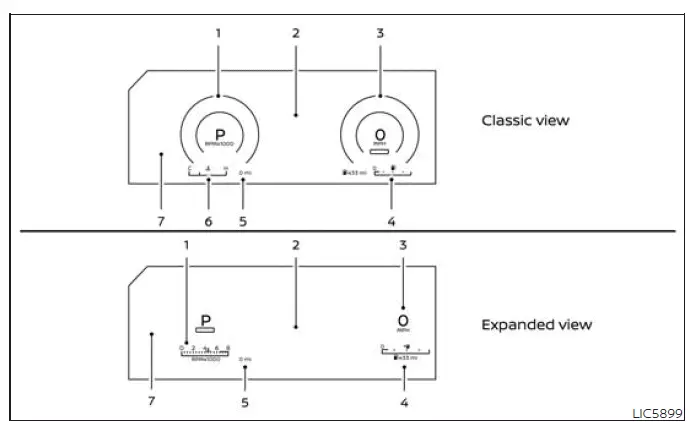
- Tachometer, used to show engine speed in revolutions per minute so the driver can monitor how the engine is operating.
- Vehicle information display, which presents key driving information, messages, and selected vehicle status details within the meter cluster.
- Speedometer, positioned to show current vehicle speed clearly while driving.
- Fuel gauge, used to indicate the approximate amount of fuel remaining in the tank.
- Odometer, which records the total distance the vehicle has been driven.
- Engine coolant temperature gauge, used to monitor the approximate operating temperature of the engine coolant.
- Warning and indicator lights, which alert the driver to operating conditions, system status, or situations that may require attention.
Speedometer and odometer
Basic Information
This vehicle is equipped with a speedometer and odometer. The speedometer is located on the right side of the meter cluster, where it can be read quickly during normal driving. In the Nissan Murano, this layout helps keep essential speed information in the driver's direct field of view.
The odometer is located within the vehicle information display. It provides the total accumulated driving distance and is part of the main information area used for vehicle monitoring.
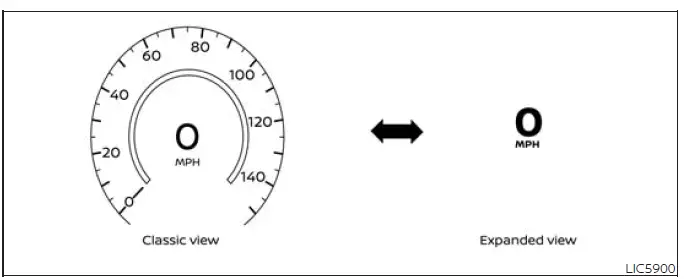
Speedometer
The speedometer indicates vehicle speed. The driver should use this display to maintain an appropriate speed for road, traffic, weather, and legal conditions.
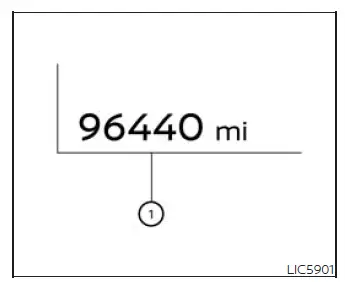
Odometer
The odometer 1 is displayed in the vehicle information display when the ignition switch is placed in the ON position. This allows the total mileage reading to be checked when the vehicle systems are active.
The odometer records the total distance the vehicle has been driven. This information is useful for maintenance planning, service history, ownership records, and general vehicle condition tracking.
Tachometer
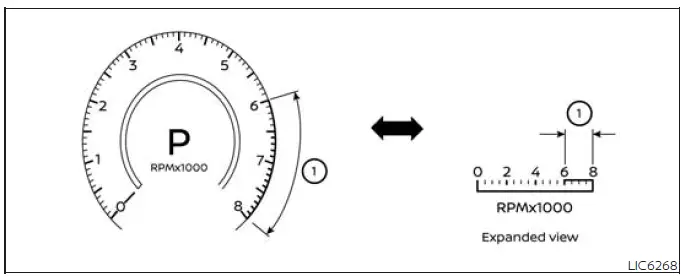
The tachometer indicates engine speed in revolutions per minute (rpm). Do not rev the engine into the red zone 1. Watching the tachometer helps the driver avoid excessive engine speed, especially during acceleration, manual-style shifting, or driving situations where engine load changes quickly.
CAUTION When engine speed approaches the red zone, reduce engine speed. Operating the engine in the red zone may cause serious engine damage. In the Nissan Murano, the tachometer should be used as a guide to keep engine operation within the safe range shown on the display.
Engine coolant temperature gauge
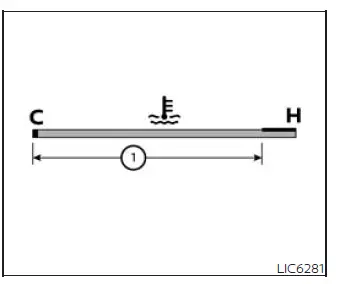
The gauge indicates the engine coolant temperature. The engine coolant temperature is within the normal range 1 when the gauge needle points within the zone shown in the illustration. This gauge helps the driver monitor whether the engine is warming up, operating normally, or approaching a temperature that may require attention.
The engine coolant temperature varies with the outside air temperature and driving conditions. Heavy traffic, high outside temperatures, long climbs, or demanding driving conditions may cause the reading to change, so the gauge should be checked whenever engine temperature becomes a concern.
NOTE:
- The engine coolant temperature gauge is not shown when the meter screen view is set to Expanded view. If temperature information is needed, use a meter view that displays the gauge.
CAUTION If the gauge indicates coolant temperature near the hot (H) end of the normal range, reduce vehicle speed to help decrease temperature. If the gauge is over the normal range, stop the vehicle as soon as it is safely possible. If the engine is overheated, continued operation of the Nissan Murano may seriously damage the engine, so the warning should be treated promptly and carefully.
Fuel gauge
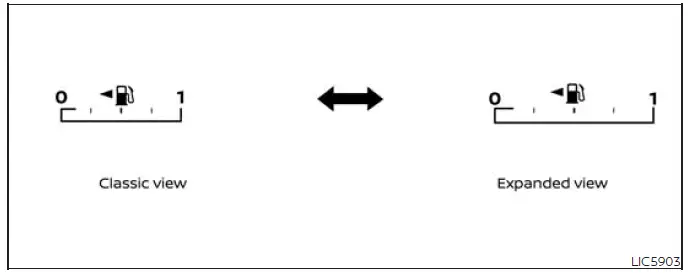
The gauge indicates the approximate fuel level in the tank. It provides the driver with a quick visual reference for remaining fuel, but the reading should be understood as an estimate rather than an exact measurement.
The gauge may move slightly during braking, turning, acceleration, or going up or down hills. This movement can occur because fuel shifts inside the tank as the vehicle changes speed, direction, or angle.
The gauge needle returns to 0 (Empty) after the ignition switch is placed in the OFF position. When the ignition is turned back ON, the gauge will display the fuel level according to the amount of fuel detected in the tank.
The low fuel warning message shows in the vehicle information display when the amount of fuel in the tank is getting low. When this message appears, refueling should be planned soon rather than waiting until the gauge reaches Empty.
Refill the fuel tank before the gauge registers 0 (Empty).
The
 indicates that the
fuel-filler door is located on the driver's side of the vehicle. This indicator is useful when approaching a
fuel pump, especially if the driver is unfamiliar with the Nissan Murano or has recently changed vehicles.
indicates that the
fuel-filler door is located on the driver's side of the vehicle. This indicator is useful when approaching a
fuel pump, especially if the driver is unfamiliar with the Nissan Murano or has recently changed vehicles.
NOTE:
- If a small amount of fuel is added, or the ignition is on during refueling, the fuel gauge may take longer to update. Allow the system time to recalculate the fuel level before relying on the displayed reading.
CAUTION
- If the vehicle runs out of fuel, the
 Malfunction Indicator Light (MIL) may come on. Refuel as soon as possible to help restore normal
operation and avoid problems caused by driving without fuel.
Malfunction Indicator Light (MIL) may come on. Refuel as soon as possible to help restore normal
operation and avoid problems caused by driving without fuel.
After a few driving trips, the
 light should turn off. If the light remains on after a few driving trips, have the vehicle
inspected. It is recommended that you visit a NISSAN dealer for this service, because the system may
require proper diagnosis if the warning does not clear after refueling.
light should turn off. If the light remains on after a few driving trips, have the vehicle
inspected. It is recommended that you visit a NISSAN dealer for this service, because the system may
require proper diagnosis if the warning does not clear after refueling.
Distance To Empty (DTE)
Distance To Empty (DTE) displays the estimated distance the vehicle can be driven before refueling. The value is calculated based on recent fuel economy, the amount of fuel remaining in the fuel tank, and actual fuel consumption. In the Nissan Murano, this information helps the driver plan refueling stops, but it should not be treated as a guaranteed remaining range.
Changes in driving patterns or conditions can cause the DTE value to vary. As a result, the value displayed may differ from the actual distance that can be driven. Acceleration habits, traffic conditions, idling, road grade, weather, and load can all influence the estimate as driving continues.
DTE display will change to "---" when the fuel level in the tank is getting low, prior to the fuel gauge reaching 0 (Empty). When this happens, refuel as soon as practical instead of attempting to drive until the tank is empty.
NOTE:
- The DTE value after refill is estimated based on recent fuel economy and the amount of fuel added. Because it uses recent driving data, the displayed range may change after several miles of driving.
- If a small amount of fuel is added, or the ignition is on during refueling, the display may not update correctly. A larger refuel amount and normal ignition cycling can help the system provide a more stable reading.
- Conditions that affect fuel economy will also affect the estimated DTE value, including city or highway driving, idle time, remote start time, terrain, seasonal weather, added vehicle weight, added deflectors, roof racks, and similar factors. For this reason, the Nissan Murano DTE reading should be used as a planning aid, while the fuel gauge and low fuel warning should still be monitored carefully.
See also:
Cargo light
The cargo light on the overhead trim has a threeposition
switch. To operate, push the switch to
the desired position.
1 ON: The light is illuminated.
2 DOOR: The light illuminates when the liftg ...
Forward-facing child restraint installation using
LATCH (Hardtop models only)
Refer to all Warnings and Cautions in the “Child
safety” and “Child restraints” sections before
installing a child restraint.
Follow these steps to install a forward-facing
child restrai ...
Basic Information. BSW system operation
Basic Information
WARNING Failure to follow the warnings and instructions for proper use of the Blind Spot
Warning system could result in a collision, serious injury, or death.
The BSW sy ...