
LDW system limitations
WARNING The limitations of the Lane Departure Warning system are described below. Failure to understand these restrictions or follow the instructions for proper LDW operation could reduce the effectiveness of the warning function and may result in loss of vehicle control, serious injury, or death.
- The LDW system does not operate at speeds below approximately 37 mph (60 km/h). It also cannot provide a lane-departure warning when the front camera is unable to recognize the lane markings.
- Do not rely on the LDW system under any of the following driving conditions, because the camera may not
detect the road boundaries accurately and the system may not operate as intended:
- During adverse weather, including rain, fog, snow, or other conditions that reduce visibility.
- When driving on slippery surfaces covered with ice, packed snow, or similar materials that may affect vehicle stability.
- When traveling on winding, rough, uneven, or heavily undulating roads where the vehicle's path changes frequently.
- Where a lane has been closed, redirected, or partially obstructed because of road construction or repair work.
- When the Nissan Murano is traveling in a temporary, improvised, or construction-zone lane that does not have normal road markings.
- On roads where the traffic lane is unusually narrow and there is limited distance between the vehicle and the lane boundaries.
- When the tires are not in normal operating condition, including excessive wear, incorrect inflation pressure, use of a spare tire, installation of tire chains, or the use of nonstandard wheels.
- When the vehicle is equipped with non-original brake or suspension components that may alter handling, ride height, or vehicle response.
- When towing a trailer or another vehicle, because the additional load and altered handling characteristics may affect system performance.
- The LDW system may also provide delayed, incorrect, or no warnings under the following road, traffic,
lighting, and camera-visibility conditions:
- On roads with several parallel markings, faded or poorly painted lines, yellow lane markings, nonstandard markings, or lines that are partly covered by water, mud, dirt, snow, or other material.
- On roads where old, discontinued, or partially removed lane markings remain visible and may be mistaken for the current lane boundaries.
- On roads with sharp curves where the camera cannot continuously identify the lane ahead of the Nissan Murano.
- Where strongly contrasting objects or patterns appear on the road, including shadows, snow, standing water, wheel ruts, pavement joints, repair seams, or lines left by road work. The camera may incorrectly interpret these features as lane markings.
- Where the current traffic lane merges with another lane, divides into multiple lanes, or changes width abruptly.
- When the direction of vehicle travel is not aligned with the detected lane markings, such as during a lane change, evasive maneuver, or irregular road approach.
- When driving very close behind another vehicle and that vehicle blocks the front camera's view of the road markings.
- When rain, snow, ice, dirt, stickers, or another object covers the windshield area directly in front of the lane camera unit.
- When the headlights provide insufficient illumination because the lenses are dirty, damaged, or incorrectly aimed.
- When intense light shines directly into the lane camera, such as low sunlight facing the front of the vehicle at sunrise or sunset.
- When surrounding brightness changes suddenly, including when the Nissan Murano enters or leaves a tunnel, passes beneath a bridge, or moves rapidly between bright sunlight and deep shadow.
- The steering-wheel vibration may be weak or difficult to feel on certain road surfaces, particularly when normal road vibration is already being transmitted through the steering system. Always watch the road and lane boundaries instead of relying only on the vibration alert.
System temporarily unavailable
If the Nissan Murano is parked in direct sunlight under high-temperature conditions above approximately 104°F (40°C) and then started, the Lane Departure Warning system may deactivate automatically to protect the front camera from excessive heat. When this occurs, the message "Unavailable Camera Temperature High" will appear in the vehicle information display.
After the passenger compartment and the area surrounding the camera have cooled sufficiently, the LDW system will resume operation automatically. No manual reactivation is normally required once the camera temperature returns to its operating range.
The LDW system is not designed to issue a lane-departure warning under either of the following conditions:
- When the turn signal is activated and the Nissan Murano changes lanes in the direction indicated by the signal. The LDW system will become available again approximately 2 seconds after the turn signal has been switched off.
- When vehicle speed decreases below approximately 37 mph (60 km/h), which is outside the operating speed range of the warning function.
Once these conditions have ended and all required operating conditions are satisfied, the LDW functions will resume automatically. The driver must continue monitoring lane position throughout any period when warnings are unavailable.
System malfunction
If the LDW system detects a malfunction, it will cancel automatically and the "Malfunction See Owner's Manual" warning message will appear in the vehicle information display. Lane-departure alerts should not be expected while this message remains displayed.
If the "Malfunction See Owner's Manual" message appears, move the Nissan Murano off the road and stop in a safe location. Place the transmission in P (Park), move the ignition switch to the OFF position, and then restart the engine. If the warning message continues to appear in the vehicle information display after restarting, have the LDW system inspected. NISSAN recommends visiting a NISSAN dealer for this service.
System maintenance
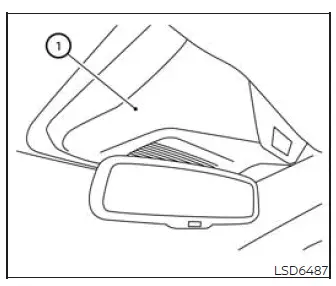
Lane camera unit 1 used by the LDW system is located above the inside rearview mirror. To support accurate lane-marker detection, maintain proper system operation, and reduce the possibility of a malfunction, observe the following precautions:
- Keep the windshield clean at all times, especially the area directly in front of the lane camera unit. Dirt, moisture, snow, ice, or other contamination can obstruct the camera's view of the road.
- Do not attach stickers, including transparent films or materials, and do not install accessories near the camera unit. Objects in this area may block or distort the camera's field of view.
- Do not place reflective materials, such as white paper, polished objects, or mirrors, on the instrument panel. Reflected sunlight may enter the camera and interfere with its ability to identify lane markings correctly.
- Do not strike, modify, or damage the windshield or trim surrounding the camera unit. Do not touch the camera lens or remove the screw installed on the unit. If the camera or the surrounding area is damaged in an accident, NISSAN recommends having the Nissan Murano inspected by a NISSAN dealer.
See also:
How to adjust the screen
To adjust the Display ON/OFF, Brightness, Tint,
Color, Contrast and Black Level of the RearView
Monitor, push the SETTING button with the
RearView Monitor on, select the item key and
adjust the le ...
If your vehicle overheats
WARNING
● Do not continue to drive if your vehicle
overheats. Doing so could cause engine
damage or a vehicle fire.
● To avoid the danger of being scalded,
never remove the radiator o ...
Operating tips
● When the engine coolant temperature and
outside air temperature are low, the air flow
from the foot outlets may not operate for a
maximum of 150 seconds. However, this is
not a malfunction ...