
Basic information
WARNING Failure to follow the warnings and instructions for the correct use of the Intelligent Blind Spot Intervention (I-BSI) system could result in a collision, serious injury, or death.
- The I-BSI system does not replace proper driving procedures and is not designed to prevent every collision with another vehicle or object. Before changing lanes, always check the side and rearview mirrors, activate the turn signal, turn your head, and look in the intended direction of travel to confirm that the lane is clear. Never rely solely on the I-BSI system to determine whether a lane change is safe.
- The detection capabilities of the radar sensors and camera are limited.
Not every moving object or vehicle will be detected. Certain road surfaces, ground conditions, lane markings, traffic situations, and weather conditions may interfere with detection or cause the I-BSI system to operate incorrectly or unexpectedly.
Remain attentive, maintain control of the Nissan Murano, and rely on your own observations and driving decisions to avoid a collision.
The I-BSI system helps alert the driver when another vehicle is detected in an adjacent lane during a potential lane change. If the vehicle approaches a lane marker while another vehicle is within the monitored area, the system can also provide brief steering assistance to help guide the Nissan Murano back toward the center of its current lane.
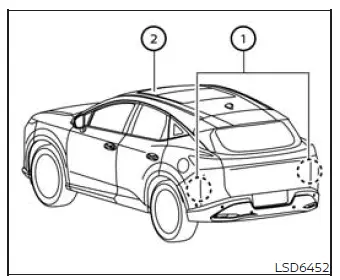
The I-BSI system uses radar sensors 1 installed near the rear bumper to monitor vehicles traveling in the adjacent lanes. In addition to the radar sensors, the system uses a camera 2 mounted behind the windshield to observe the lane markers bordering the vehicle's current lane. Information from these components allows the system to determine when a detected vehicle and movement toward a lane marker may create a potential lane-change hazard.
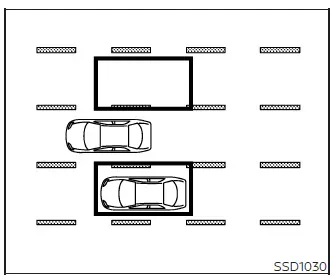
Detection zone
The radar sensors can detect vehicles on either side of the Nissan Murano when they are positioned within the detection zones shown in the illustration. Detection may vary according to the position and movement of the surrounding vehicle.
The detection zone begins near each outside mirror and extends approximately 10 ft (3.0 m) behind the rear bumper and approximately 10 ft (3.0 m) outward to the side. Vehicles outside these monitored areas may not be detected by the radar sensors.
See also:
System temporarily unavailable
Basic Information
When the system detects that one or both radar sensors are blocked or unable to operate correctly, the BSW system
is automatically deactivated. This temporary shutdown preven ...
Seat belt maintenance
• To clean
the seat belt webbing, apply a
mild soap solution or any solution recommended
for cleaning upholstery or carpets.
Then wipe with a cloth and allow the seat
belts to dry in the sha ...
How to use brightness control and display ON/OFF button
Push the “ OFF” button to switch
the display
brightness to the daytime mode or the nighttime
mode, and to adjust the display brightness using
the multi-function controller while the indicator ...