
AEB with Pedestrian Detection system limitations
WARNING The following limitations apply to the AEB with Pedestrian Detection system. Failure to operate the Nissan Murano in accordance with these limitations could result in a collision, serious injury, or death.
- The AEB with Pedestrian Detection system cannot identify every vehicle or pedestrian under all driving, traffic, visibility, weather, and road conditions. The driver must continuously monitor the road ahead and remain prepared to steer or brake without waiting for the system to respond.
- The AEB with Pedestrian Detection system is not designed to detect the following:
- Small pedestrians, including children, or pedestrians who are sitting, using toys or skateboards, riding scooters, using wheelchairs, or otherwise not in an upright standing or walking position.
- Animals, regardless of their size.
- Roadway or roadside obstacles such as loose cargo, debris, or other objects that are not recognized as vehicles or pedestrians.
- Vehicles approaching from the opposite direction or crossing the path of the vehicle.
- Vehicles whose tires are difficult to identify or whose rear profile is unclear, unusually shaped, covered, or obstructed.
- Parked vehicles that the system does not recognize as a collision risk.
- Junction Assist is not designed to detect the following:
- An oncoming vehicle positioned directly in front of your vehicle rather than crossing the projected turning path.
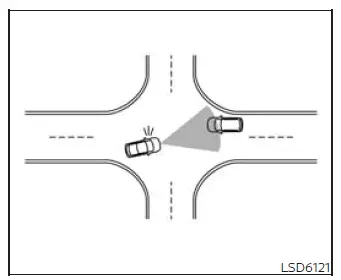
WARNING
- The AEB with Pedestrian Detection system has operating and detection limitations that vary with vehicle
speed and the type of object ahead.
- If a stationary vehicle is located in the Nissan Murano travel path, the system will not operate when the vehicle approaches it at a speed above approximately 50 mph (80 km/h).
- The pedestrian detection function does not operate when vehicle speed is above approximately 50 mph (80 km/h) or below approximately 6 mph (10 km/h).
- The AEB with Pedestrian Detection system may not operate correctly or may be unable to detect a vehicle or
pedestrian ahead under the following conditions:
- When visibility is reduced by rain, snow, fog, dust, sand, smoke, road spray from other vehicles, or similar environmental conditions.
- When dirt, mud, ice, snow, condensation, fog, or another material covers the radar sensor area or the windshield area in front of the camera.
- When intense light, such as direct sunlight or high-beam headlights, enters the front camera, or when brightness changes suddenly, such as when entering a tunnel or driving during lightning.
- When driving in darkness or poorly illuminated areas, including at night or inside tunnels, especially when the vehicle headlights are off or dim or when the tail lights of the vehicle ahead are not illuminated.
- When the front camera is misaligned and cannot accurately monitor the roadway ahead.
- When driving down a steep slope, through sharp curves, or over rough, uneven, unpaved, or dirt roads.
- When signals from other radar sources interfere with the front radar sensor.
- When the position or movement of your vehicle changes quickly or significantly, such as during a lane change, turn, abrupt steering input, sudden acceleration, or sudden deceleration.
- When your vehicle, the vehicle ahead, or a pedestrian moves so quickly or unexpectedly that the system does not have sufficient time to detect the situation and respond. Examples include a pedestrian entering the path at close range or a vehicle cutting in, changing lanes, turning, steering abruptly, accelerating, or decelerating suddenly.
- When the vehicle or pedestrian is positioned outside or offset from the projected forward path of your vehicle.
- When the difference in speed between your vehicle and the vehicle ahead is too small for the system to identify a developing collision risk reliably.
- When the outline of a pedestrian is partly hidden or difficult to identify, such as when the person is carrying luggage, pushing a stroller, wearing bulky or very loose clothing or accessories, or holding an unusual posture such as raising their arms.
- When the pedestrian has poor visual contrast with the surrounding background, including clothing colors or patterns that closely resemble nearby objects or scenery.
- During the first approximately 15 seconds after the engine is started, while the system is becoming available.
- When the vehicle ahead has an unusual shape, an extremely low or high ground clearance, an uncommon cargo arrangement, or a narrow profile such as a motorcycle.
- When a vehicle or pedestrian is close to a traffic sign, a reflective surface such as water on the road, or an area of deep shadow that may make identification more difficult.
- When several pedestrians are standing or moving closely together and cannot be recognized individually.
- When a pedestrian is partly or completely hidden by another vehicle, roadside structure, or other object.
- While the vehicle is towing a trailer or another vehicle, which may affect system operation and vehicle response.
- Junction Assist may not function correctly or may be unable to detect an oncoming vehicle or pedestrian
under the following conditions:
- When making a right or left turn from a traffic lane separated from oncoming vehicles by more than two lanes.
- When the vehicle is not directed toward the path of an oncoming vehicle during a right or left turn.
- When crossing an oncoming traffic lane as another vehicle approaches and the developing situation cannot be recognized in time.
- When making a sharp turn or following a particularly wide curve.
- When the system cannot recognize the roadway center line.
- When several oncoming vehicles are traveling closely behind one another in a continuous line.
- When the traffic lane is significantly wider or narrower than a typical lane.
- When the center line is positioned close to another road marking, making the lane layout difficult for the system to interpret accurately.
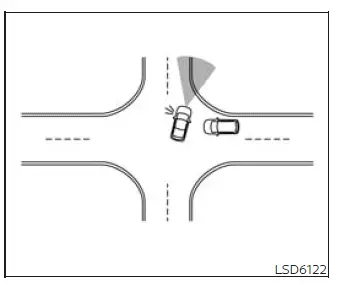
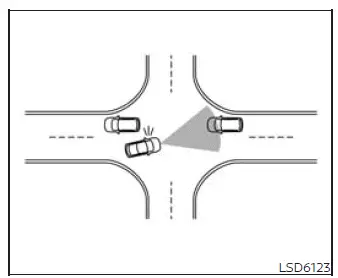
WARNING
- Performance of the AEB with Pedestrian Detection system may be reduced under the following
conditions:
- When the Nissan Murano is traveling on a wet, icy, snowy, or otherwise slippery road surface.
- When the vehicle is being driven uphill, downhill, or on another sloped roadway.
- When excessively heavy baggage or cargo is carried on the rear seat or in the cargo area, affecting the vehicle's position or response.
- The system is designed to check the operation of the radar sensor and front camera automatically, but this diagnostic capability has limitations. Certain obstructions, including ice, snow, stickers, or similar material covering a sensor area, may not always be recognized. Under these circumstances, the system may be unable to detect hazards or warn the driver correctly. Inspect the radar and camera areas regularly and keep them clean, clear, and unobstructed.
- Under some road and traffic conditions, the AEB with Pedestrian Detection system may apply partial braking unexpectedly. If acceleration is required and the surrounding conditions are safe, press the accelerator pedal to override the braking response.
- The system may activate after detecting a pattern, object, shadow, reflection, or light arrangement that resembles the outline of a vehicle or pedestrian. It may also respond to lights that appear similar in size and position to the tail lights of a vehicle or motorcycle.
- The AEB with Pedestrian Detection system may continue operating while the vehicle ahead is turning right or left and leaving the Nissan Murano travel path.
- The system may activate while your vehicle approaches and passes another vehicle traveling ahead.
- Roadway shape and lane configuration can cause the system to respond temporarily to an oncoming vehicle. This may occur on curved or winding roads, near the entrance or exit of a curve, in areas with lane restrictions, or while traveling through construction zones and other changing road layouts.
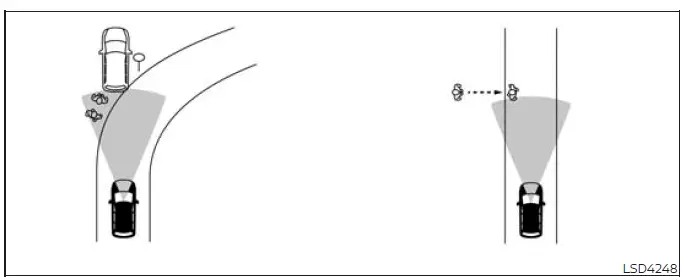
WARNING The following warnings apply to the operation of the AEB with Pedestrian Detection system:
Below are the operating limitations of the AEB with Pedestrian Detection system. Failure to drive the Nissan Murano in accordance with these limitations could result in a collision, serious injury, or death.
- The AEB with Pedestrian Detection system may respond to certain objects, people, vehicles, or roadway
features even when they are not directly blocking the vehicle's path, including:
- Objects or road users positioned along the roadside, such as traffic signs, guardrails, pedestrians, motorcycles, or vehicles.
- Pedestrians located in narrow streets, alleys, or other confined driving areas where they may be close to the vehicle's projected path.
- Pedestrians who briefly step into or approach the travel lane while moving around an obstacle on the road shoulder.
- Objects extending over the roadway, including low bridges, overhead traffic signs, or similar structures.
- Objects or changes in the road surface, such as railroad tracks, drainage grates, steel plates, or comparable features.
- Structures inside parking garages, including beams, pillars, or other objects positioned close to the vehicle.
- Pedestrians or motorcycles approaching the current travel lane.
- Vehicles, pedestrians, motorcycles, or other objects located in adjacent lanes or passing close to the Nissan Murano.
- Pedestrians approaching from the opposite direction.
- Roadside objects such as trees or other large stationary features near the roadway.
- While the vehicle is making a right or left turn, Junction Assist may respond in the following
situations:
- When an oncoming vehicle or crossing pedestrian has already moved out of the projected path of your vehicle.
- When your vehicle is positioned very close to an oncoming vehicle or a pedestrian crossing ahead.
- When an oncoming vehicle or crossing pedestrian stops before entering the projected path of your vehicle.
- When an oncoming vehicle turns right or left across or near the front of your vehicle.
- Junction Assist may also respond when the movement of an oncoming vehicle is difficult to predict because that vehicle turns suddenly, changes direction, or decelerates unexpectedly.
- Braking distance increases on wet, icy, snowy, or otherwise slippery road surfaces. Automatic braking may therefore be unable to stop the vehicle within the expected distance, and the driver must apply the brake pedal as necessary.
- Excessive noise inside or outside the vehicle may interfere with the warning chime and make it difficult to hear. High audio volume, open windows, or surrounding traffic noise must not prevent the driver from monitoring visual warnings and road conditions.
See also:
Instrument panel
1. Side ventilator
2. Meters and gauges
3. Push-button ignition switch
4. Center ventilator
5. Center display
— Center color display
— Navigation system
6. Heater/air conditioner control ...
How to use the STATUS button
The STATUS button is used to display system information.
Three different split screens of information
are available. Press the STATUS button multiple
times to cycle through these screens as follo ...
Tire Pressure Monitoring System (TPMS)
Each tire, including the spare (if provided),
should be checked monthly when cold and
inflated to the inflation pressure recommended
by the vehicle manufacturer on the vehicle
placard or tire infl ...