
System maintenance
Basic Information
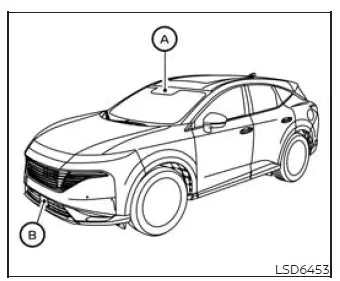
Radar sensor B is installed at the front of the vehicle, while camera A is positioned near the upper section of the windshield. Together, these components monitor the road ahead and provide the information required for the AEB with Pedestrian Detection system to operate.
To support accurate detection and reliable operation of the AEB with Pedestrian Detection system in the Nissan Murano, follow these maintenance precautions:
- Keep the sensor areas on the front bumper or emblem and the windshield clean and free from dirt, mud, snow, ice, moisture, insects, and other material that could interfere with detection.
- Do not strike, scratch, or otherwise damage the areas surrounding the sensors, including the front bumper and windshield. Even damage that appears minor may affect sensor alignment or performance.
- Do not cover the sensors, attach stickers near them, or install accessories that could obstruct their field of view or interfere with radar signals. Any blockage may reduce system performance or cause a failure or malfunction.
- Do not install metallic objects, such as a brush guard or similar accessory, near the radar sensor. Metal components in this area may interfere with radar operation and cause incorrect detection or a system malfunction.
- Do not place highly reflective materials, including white paper, mirrors, or similar objects, on the instrument panel. Reflected sunlight may enter the camera and reduce its ability to identify vehicles, pedestrians, and roadway conditions accurately.
- Do not modify, remove, repaint, or improperly repair the front bumper. Sensor positioning and surrounding materials can affect radar performance. Before customizing or restoring the front bumper, it is recommended that you consult a NISSAN dealer.
Radio frequency statement
For USA
This device complies with Part 15 of the FCC Rules. Its operation is subject to the following two conditions:
1. This device may not cause harmful interference, and
2. This device must accept any interference received, including interference that may cause undesired operation.
FCC Warning
Changes or modifications that are not expressly approved by the party responsible for compliance may void the user's authority to operate this equipment.
For Canada
This device complies with Part 15 of the FCC Rules and with the applicable Industry Canada licence-exempt RSS standards. Its operation is subject to the following two conditions:
1. This device may not cause interference, and
2. This device must accept any interference received, including interference that may cause undesired operation of the device.
Radio frequency radiation exposure information: This equipment complies with FCC and IC radiation exposure limits established for an uncontrolled environment.
The equipment should be installed and operated with a minimum distance of 30 cm between the radiator and the user's body.
This transmitter must not be located or operated together with any other antenna or transmitter.
FCC Notice
Changes or modifications that are not expressly approved by the party responsible for compliance may void the user's authority to operate the equipment.
See also:
Basic Information
WARNING
Failure to correctly adjust the brightness and position of the displayed image may interfere with the
driver's ability to see clearly through the windshield. Reduced forwar ...
Steering wheel switch for audio control
1. Menu control switch/ENTER button
2. BACK switch
3. Volume control switch
4. Power on and SOURCE select switch
The audio system can be operated using the
controls on the steering wheel.
POW ...
All-Wheel Drive (AWD)
If a malfunction or abnormal operating condition is detected in the All-Wheel Drive system while the engine is
running, a corresponding warning message will appear in the meter. The message identif ...