
Basic Information
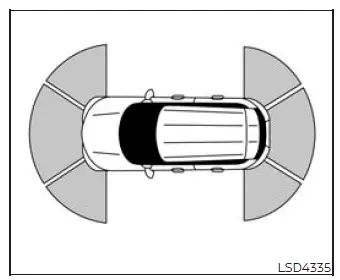
The front and rear sonar system uses ultrasonic sensors installed in the front and rear bumpers to detect certain obstacles near the vehicle. When an object is detected, the system sounds a tone to help inform the driver of its proximity.
When the sonar system is enabled, the sonar view automatically appears on the center display when the operating conditions require it, providing a visual indication of detected objects around the Nissan Murano.
WARNING
- The sonar system is a convenience feature intended to assist with low-speed maneuvering, but it is not a substitute for proper parking technique, direct observation, or careful vehicle control.
- The driver remains fully responsible for safety during parking and all other maneuvers.
Before moving the vehicle, look in every direction, check mirrors and available camera views, and confirm that the intended path is clear.
- Read and understand all sonar-system limitations described in this section. The colors shown by the sonar indicator represent different approximate distances between the vehicle and a detected object.
- Severe weather and nearby ultrasonic sources may interfere with sonar operation. Automatic car-wash equipment, compressed-air brakes on trucks, pneumatic drills, and similar sources can reduce detection performance or cause false warnings.
- The sonar system is primarily designed to assist the driver in detecting certain large, stationary objects and may help reduce the risk of vehicle damage during low-speed maneuvering.
- The sonar system is not designed to prevent contact with every small, low, or moving object. Always maneuver slowly and remain prepared to stop. The sensors may not detect objects located below the bumper, directly against the bumper, or flat on the ground.
- The sonar system may have difficulty detecting soft or sound-absorbing objects such as snow, fabric, cotton, or glass wool. It may also fail to identify thin objects, including rope, wire, or chain, as well as objects with a narrow or wedge-shaped surface.
- The front and rear sonar sensors calculate distance by receiving sound waves reflected from the surface of an obstacle. Loud horns or nearby ultrasonic signals, including sonar emitted by another vehicle, may interfere with these reflected waves and prevent reliable object detection.
If the bumper fascia is damaged, bent, displaced, or no longer correctly aligned, the sonar sensing area may change. This can produce inaccurate distance indications, missed detections, or false alarms. Have damaged bumper components and sensor alignment inspected as necessary.
CAUTION
- Excessive cabin or exterior noise, including high audio-system volume or sound entering through an open window, can make the sonar warning tone difficult to hear. Keep the volume at a level that allows warning sounds to remain audible while maneuvering.
- Keep the sonar sensors located in the bumper fascia free from snow, ice, mud, and heavy accumulations of
dirt.
Do not scrape, probe, or clean the sensors with sharp objects, as this could damage their surfaces. When one or more sensors are covered or obstructed, the accuracy and reliability of the sonar function will be reduced.
See also:
Hood
1. Pull the hood lock release handle 1, located below the instrument panel on the driver's side, until the
primary latch releases and the hood rises slightly. Make sure the Nissan Murano ...
Phonebook registration
When the cellular phone is connected to the invehicle
module, the data stored in the cellular
phone such as phonebook, outgoing call logs,
incoming call logs and missed call logs is
automaticall ...
Startup display
When the vehicle in placed in the ON or ACC
position the screens that display in the vehicle
information include:
● Active system status (if so equipped)
● Trip computer
● Tire ...