
Basic information. Towing recommended by NISSAN
Basic information
When towing your Nissan Murano, all applicable jurisdictional and local towing regulations must be followed. Using unsuitable equipment or an incorrect towing method may damage the vehicle. Detailed towing instructions are available from a NISSAN dealer, and local towing operators are generally familiar with the laws, equipment requirements, and procedures that apply in the area. To help ensure correct handling and prevent accidental vehicle damage, NISSAN recommends having the vehicle transported by a qualified towing service. Ask the service operator to review the following precautions before towing begins:
WARNING
- Never allow anyone to remain inside or ride in a vehicle while it is being towed.
- Never crawl or stand beneath the vehicle after it has been raised by a tow truck. The vehicle could shift or fall and cause serious injury.
CAUTION
- Before towing, make sure the transmission, axles, steering system, and powertrain are in operating condition. If any of these systems are damaged or cannot function normally, wheel dollies or a flatbed tow truck must be used to prevent further damage.
- Always attach the required safety chains securely before the vehicle is towed.
Towing recommended by NISSAN
Basic information
NISSAN recommends selecting the towing method according to the vehicle's drivetrain configuration. Refer carefully to the diagrams and instructions in this section before the Nissan Murano is moved, as using an unsuitable towing method may damage the transmission, drivetrain, or related components.
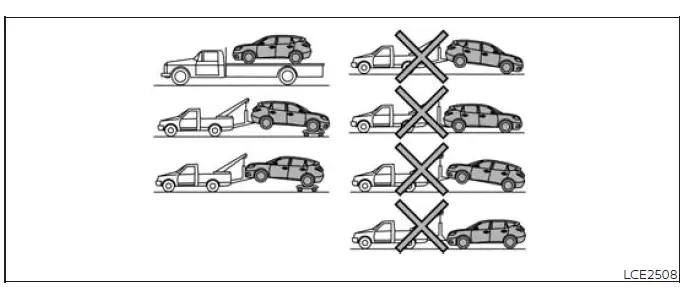
All-Wheel Drive (AWD) models with automatic transmission
For an All-Wheel Drive model, NISSAN recommends placing the vehicle completely on a flatbed truck or using towing dollies in the arrangement shown in the illustration. The selected method must keep every wheel off the road while the vehicle is being transported.
CAUTION Never tow an All-Wheel Drive (AWD) model equipped with an automatic transmission while any wheel remains on the ground. Doing so may cause serious and costly damage to the Nissan Murano powertrain.
NOTE: If the battery is completely discharged, the transmission cannot be shifted manually into another position.
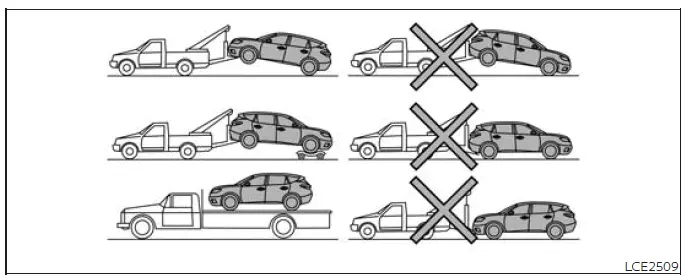
Two-Wheel Drive models with automatic transmission
For a Two-Wheel Drive model, NISSAN recommends towing the vehicle with the driven front wheels raised completely off the ground. The vehicle may also be transported on a flatbed truck in the manner shown in the illustration.
CAUTION
- Never tow an automatic transmission model with the front wheels on the ground or with all four wheels on the ground, whether the vehicle is facing forward or backward. This can cause severe and expensive transmission damage. If the Nissan Murano must be towed with the rear wheels raised, always place towing dollies beneath the front wheels.
- When towing an automatic transmission model with the rear wheels on the ground or supported by towing
dollies:
- Place the ignition switch in the OFF position and secure the steering wheel in the straight-ahead position with a rope or a similar suitable device. Do not secure the steering wheel by turning the ignition switch to the LOCK position, as this may damage the steering lock mechanism on models equipped with one.
NOTE: If the battery is completely discharged, the transmission cannot be shifted manually into another position.
See also:
Air fresheners
Most air fresheners use a solvent that could affect
the vehicle interior. If you use an air freshener,
take the following precautions:
● Hanging-type air fresheners can cause permanent
disco ...
Basic Information. AEB with Pedestrian Detection system
operation
Basic Information
WARNING Failure to follow the warnings and operating instructions for the Automatic Emergency
Braking (AEB) with Pedestrian Detection system could result in a collision, serious ...
Conditions the remote start will not work
The remote start will not operate if any of the
following conditions are present:
● The ignition switch is placed in the ON position.
● The hood is not securely closed.
● The haz ...