
Other supplemental front-impact air bag precautions
WARNING
- Do not place any objects on the steering wheel pad or on the instrument panel. Also, do not place any items between any occupant and the steering wheel or instrument panel. If the front air bags inflate, loose or improperly positioned objects can be thrown with significant force and may become dangerous projectiles, increasing the risk of injury to the driver or front passenger.
- Immediately after inflation, several front air bag system components will be hot. Do not touch these parts after deployment; contact with heated components may cause severe burns. Allow the area to cool and avoid handling any air bag-related parts after a collision.
- No unauthorized changes should be made to any components or wiring of the supplemental air bag system in
the Nissan Murano.
This precaution helps prevent accidental inflation of the supplemental air bag, improper deployment, or damage to the supplemental air bag system. Even small changes to wiring, connectors, trim, or related components can affect how the system responds in a collision.
- Do not make unauthorized changes to your vehicle's electrical system, suspension system, or front end structure. These areas can influence how impact forces are detected and transmitted, and improper modification could affect correct operation of the front air bag system.
- Tampering with the front air bag system may result in serious personal injury. Tampering includes changes to the steering wheel and the instrument panel assembly, such as placing material over the steering wheel pad, adding coverings above the instrument panel, or installing extra trim material around the air bag system. These changes can interfere with deployment paths or cause parts to separate during air bag inflation.
- Removing or modifying the front passenger seat may affect the function of the air bag system and may result in serious personal injury. The front passenger seat is connected to occupant classification functions, so changes to its structure, mounting, cushion, or related components can interfere with proper system operation.
- Modifying or tampering with the front passenger seat may result in serious personal injury. For example, do not change the front seats by placing additional material on the seat cushion or by installing trim material, such as seat covers, that is not specifically designed to assure proper air bag operation. Additionally, do not store any objects under the front passenger seat or between the seat cushion and seatback. In the Nissan Murano, such objects may interfere with the proper operation of the occupant classification sensor (weight sensor) and may affect how the front passenger air bag system determines seat status.
- No unauthorized changes should be made to any components or wiring of the seat belt system. The seat belt system works together with the front air bag system, and tampering with seat belt wiring, buckles, pretensioners, or related components may affect proper restraint operation. Tampering with the seat belt system may result in serious personal injury.
- It is recommended that you visit a NISSAN dealer for work on and around the front air bag. It is also recommended that you visit a NISSAN dealer for installation of electrical equipment. The Supplemental Restraint System (SRS) wiring harnesses* should not be modified or disconnected. Unauthorized electrical test equipment and probing devices should not be used on the air bag system, because improper testing can damage sensitive components or create an unintended deployment risk.
- A cracked windshield should be replaced immediately by a qualified repair facility. A cracked windshield could affect the function of the supplemental air bag system, so glass damage on the Nissan Murano should not be ignored when it is located in an area that may influence restraint system performance.
*The SRS wiring harness connectors are yellow and orange for easy identification.
When selling your Nissan Murano, we request that you inform the buyer about the front air bag system and direct the buyer to the appropriate sections in this Owner's Manual. This helps ensure that the next owner understands how the supplemental restraint system operates, where the main warnings are located, and why correct seating position, seat belt use, and air bag precautions remain important throughout the life of the vehicle.
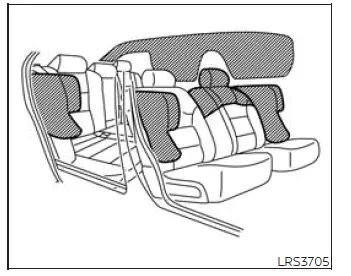
Front, rear outboard, and front central (if so equipped) seat-mounted side-impact supplemental air bag and roof-mounted curtain side-impact and rollover supplemental air bag systems
The side air bags are located in the outside of the seatback of the front and rear outboard seats. The front central air bag, if so equipped, is located in the inside of the driver's seatback. The curtain air bags are located in the side roof rails. All information, cautions, and warnings in this manual must be followed because these systems are designed to supplement, not replace, proper seat belt use and correct occupant positioning. The side air bags and curtain air bags are designed to inflate in higher severity side collisions, although they may also inflate if the forces in another type of collision are similar to those of a higher severity impact. They are designed to inflate on the side where the Nissan Murano is impacted. They may not inflate in certain side collisions, depending on the direction, force, and nature of the impact.
Curtain air bags are also designed to inflate in certain types of rollover collisions or near-rollover events. As a result, certain vehicle movements, for example during severe off-roading or abrupt body motion that resembles a rollover condition, may cause the curtain air bags to inflate. This operation is part of the system's intended response when the detected vehicle movement meets the required conditions.
Vehicle damage, or the absence of visible damage, is not always an indication of proper side air bag and curtain air bag operation. Air bag deployment is based on detected forces and vehicle movement, not simply on how the exterior of the vehicle appears after an incident.
When the side air bags and curtain air bags inflate, a fairly loud noise may be heard, followed by the release of smoke. This smoke is not harmful and does not indicate a fire. However, care should be taken not to inhale it, as it may cause irritation, coughing, or a choking sensation. Occupants with a history of asthma, allergies, or other breathing conditions should get fresh air promptly when it is safe to do so.
Side air bags, together with properly worn seat belts, help cushion the impact force on the chest and pelvic area of the front and rear outboard occupants. The front central side air bag, together with the use of seat belts, helps cushion impact force to the head area of the front occupants. Curtain air bags help cushion impact force to the head of occupants in the front and rear outboard seating positions. These systems can help save lives and reduce serious injuries in certain crashes. However, an inflating side air bag or curtain air bag deploys with considerable force and may cause abrasions, bruising, or other injuries during activation.
Side air bags and curtain air bags do not provide restraint to the lower body. For this reason, every occupant in the Nissan Murano must continue to wear the seat belt correctly and remain properly seated so the restraint systems can work together as intended.
The seat belts should be correctly worn, and the driver, front passenger, and rear outboard occupants should sit upright and as far as practical away from the side air bag locations. Leaning toward the door, resting against the seat side bolster, or placing the body too close to the roof rail area may increase the risk of injury if the air bags deploy.
Rear seat passengers should be seated as far away as practical from the door finishers and side roof rails. The side air bags and curtain air bags inflate quickly to help protect occupants during certain side-impact or rollover-related events. Because deployment happens with great speed and force, the risk of injury can increase if an occupant is too close to, leaning against, or positioned directly beside these air bag modules during inflation. Proper seating posture in the Nissan Murano is therefore an important part of side-impact and rollover protection.
The side air bag will deflate quickly after the collision is over. The front central side air bag and curtain air bags will remain inflated for a short period of time after deployment, helping maintain supplemental coverage during the immediate moments following certain side-impact or rollover-related events.
The curtain air bag will remain inflated for a short time. This short period of inflation is part of the intended operation of the system and does not indicate a malfunction.
The side air bags and curtain air bags operate only when the ignition switch is placed in the ON position.
After placing the ignition switch in the ON position, the supplemental air bag warning light illuminates. The supplemental air bag warning light will turn off after about 7 seconds if the system is operational. In the Nissan Murano, this brief illumination is part of the normal system check for the supplemental restraint system.
WARNING
- Do not place any objects near the seatback of the front and rear seats.
Also, do not place any objects, such as an umbrella, bag, package, electronic device, or other loose item, between the front and rear door finisher and the front and rear seat. If a side air bag inflates, these objects may become dangerous projectiles and may cause injury to occupants. Keep the area around the seatbacks and door trim clear so the side air bags can deploy without obstruction.
- Right after inflation, several side air bag and curtain air bag system components will be hot. Do not touch these parts immediately after deployment; contact with heated components may cause severe burns. Wait until the area is safe and avoid handling air bag-related components after a collision.
- No unauthorized changes should be made to any components or wiring of the side air bag and curtain air bag systems. This precaution helps prevent accidental inflation, improper deployment, system damage, or reduced effectiveness of the side air bag and curtain air bag systems. Wiring, connectors, sensors, seat components, roof rail trim, and related parts should remain in their original condition unless serviced properly.
- Do not make unauthorized changes to your vehicle's electrical system, suspension system or side panel.
This could affect proper operation of the side air bag and curtain air bag systems. These systems depend on the correct condition of related vehicle structures and electronic components, so improper modification may interfere with crash detection or deployment performance in the Nissan Murano.
- Tampering with the side air bag system may result in serious personal injury. For example, do not change the front and rear seats by placing material near the seatbacks or by installing additional trim material, such as seat covers, around the side air bag. Materials that are not designed for proper air bag operation may block the deployment path, alter how the seatback opens during inflation, or affect the protection intended for occupants.
- It is recommended that you visit a NISSAN dealer for work on and around the side air bag and curtain air bag. It is also recommended that you visit a NISSAN dealer for installation of electrical equipment. The SRS wiring harnesses* should not be modified or disconnected. Unauthorized electrical test equipment and probing devices should not be used on the side air bag or curtain air bag system, because improper testing or handling can damage sensitive components or create an unintended deployment risk.
* The SRS wiring harness connectors are yellow and orange for easy identification.
When selling your Nissan Murano, we request that you inform the buyer about the side air bag and curtain air bag systems and guide the buyer to the appropriate sections in this Owner's Manual. This helps the next owner understand the location of the systems, the related warnings, and the importance of avoiding unauthorized modifications or objects placed near deployment areas.
See also:
Rear seat air conditioner
1. OFF button
2. Fan speed increase (+) button
3. AUTO button
4. Temperature increase ( )
button
5. Temperature decrease ( )
button
6. Display
7. Fan speed decrease (-) button
The rear se ...
Towing load/specification
1: All towing above 1,000 lb (454 kg) requires the use of trailer brakes.
NISSAN recommends the use of a
tandem axle trailer whenever towing above 3,000 lb (1,361 kg).
2: A sway control device i ...
Where to go for service
If maintenance service is required or your vehicle
appears to malfunction, have the systems
checked and serviced by a NISSAN dealer.
NISSAN technicians are well-trained specialists
and are kept ...